Best Selling Items on Etsy: What Sells and How to Check
Etsy does not give sellers a ranked list of best-selling items. This guide shows where Etsy's own data lives, which product families it highlights, and how to judge an idea before you commit.
People search for "best selling items on Etsy" hoping for a top 10 list. We did not find one on Etsy's own seller pages, and we will not invent one. What Etsy does publish is more useful: search-based trend reports, a demand tool inside Shop Manager, and clear rules about what you may sell. This guide shows where to look, how to read it, and when an idea is ready to move to your own store.
Does Etsy publish a best-seller list?
On the Etsy pages we read for this guide, we did not find a ranked list of best-selling products with sales numbers. The nearest things are Etsy's consumer-facing Trend Edit at etsy.com/trends and the Seller Handbook trend reports, which are built on Etsy search and sales data. Sellers also get a demand tool called Marketplace Insights.
That matters because many "top 10 Etsy products" articles online print rankings and sales figures with no source. If a page does not say where the numbers come from, treat them as a guess. Etsy's own trend report labels its buyer-age data as directional and drawn from its own marketplace activity, which is the right way to read all of it.
Here is what each real source gives you, and what it leaves out.
Where to see what sells on Etsy
Etsy Marketplace Insights
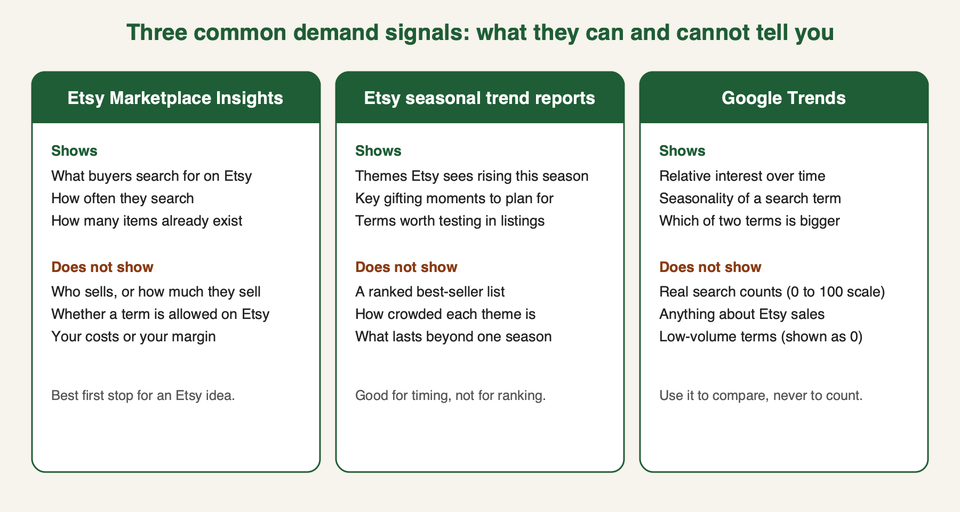
Etsy describes Marketplace Insights as a tool inside Shop Manager that uses real Etsy search data. It shows which terms buyers search for, how often, and how many items already exist for that term. Etsy's own example is comparing keywords to find ones with high demand but fewer listings, and spotting seasonal spikes such as personalised ornaments in autumn.
Two limits are worth knowing:
- Etsy's article says free searches are capped each week, and that Etsy Plus subscribers get unlimited searches. The article also called the tool a beta. Check the current limits inside Shop Manager.
- Etsy warns that the terms you see only show what buyers search for, even if the item is not allowed on Etsy. You still have to check the rules yourself.
You need an Etsy shop to use it. That is fine: opening a shop to test an idea is part of the plan later in this guide.
Etsy's seasonal trend reports
Etsy publishes a Seller Trend Report each season. The Fall and Winter 2026 report says it is based on Etsy search and sales data from the last three months, plus wider cultural forecasting. It names seven themes. Among them: maximalist holiday decor and bedazzled kits, visible handwork (hand painted, hand woven and hand thrown items), table dressing, holiday craft kits and DIY activities, vintage-style jewellery and brooches, personalised gifts for friends and pets, and unusual footwear.
The Spring and Summer 2026 report covers a different set: stitched and crochet textures, wall art and gallery prints, whimsical accessories and hobby kits. It also lists the gifting moments Etsy expects, including Mother's Day, Father's Day, graduation and Independence Day, with the themes Etsy ties to each.
Etsy also publishes a consumer-facing Trend Edit at etsy.com/trends. It shows themes and hand-picked listings, not sales rankings.
Read these as a calendar and a mood board, not a ranking. Each report shows year-on-year growth in searches for some terms. Growth from a small base can look huge, and none of it tells you how crowded a theme is.
Google Trends, used carefully
Google's own FAQ explains that Trends shows a sample of Google searches, scaled from 0 to 100 against all searches, and that low-volume terms appear as 0. It also says a spike does not mean a topic is "winning". So Google Trends can tell you whether interest in "personalised pet ornament" peaks before the holidays, or whether one term is bigger than another. It cannot tell you what sells on Etsy.
Etsy search itself
You can also type a product idea into the Etsy search bar and look at what comes up: how many results, how varied the listings are, how good the photos look. That is a quick sanity check, not data. Etsy does not describe it as a research tool on the pages we read, so use it only to judge quality and variety. Etsy marks some listings in search as Bestseller. We did not find where Etsy defines it, so treat it as a hint, not a ranking.
Which product families does Etsy itself highlight?
The table below lists only families that Etsy named in the two trend reports above, and the rule most likely to apply. It is not a ranking.
| Product family | Where Etsy mentioned it | Rule to check first |
|---|---|---|
| Craft kits and DIY activities | Fall and Winter 2026 report, Spring and Summer 2026 report | Craft supplies and kits are allowed as "sourced by a seller" |
| Hand-made textiles, ceramics and painted items | Fall and Winter 2026 report | Handcrafted by you, with photos of the finished item |
| Table and party decor | Fall and Winter 2026 report | Decor made for a specific celebration qualifies; generic tableware does not |
| Personalised gifts and pet items | Fall and Winter 2026 report, Spring and Summer 2026 report | Personalised items made by a production partner must be disclosed |
| Vintage jewellery and clothing | Fall and Winter 2026 report | Vintage means 20 years or older |
| Wall art and gallery prints | Spring and Summer 2026 report | Must be your original design; scans of other people's work are not allowed |
| Embroidered and crochet pieces | Spring and Summer 2026 report | Hand altered or handcrafted work qualifies |
A theme being on this list does not make it a good idea for you. It means Etsy has seen buyers searching for it recently.
What you can and cannot sell
Check this before you spend money on stock. Etsy's Creativity Standards say every item must be made, designed, handpicked or sourced by the seller, and each of those has limits.
- Made by you. Handcrafted, hand altered or hand assembled items, or items you produce with your own computerised tools such as a laser cutter or Cricut, from your own design. Assembling a flat-pack kit does not count.
- Designed by you. Your original designs as digital downloads, or produced by a production partner. AI-generated work from your own prompts is allowed if you say so in the listing. AI prompt bundles are not.
- Handpicked by you. Vintage items 20 years or older, items from nature, and themed gift baskets. Newer resold items that only look vintage do not qualify.
- Sourced by you. Craft supplies, party supplies and buyer-personalised items printed by a production partner. Blank, ready-to-use items such as plain t-shirts or tumblers do not qualify.
Etsy's Seller Policy adds that dropshipping and reselling are not allowed except in specific cases such as craft supplies. It also asks for your own photos, with limited exceptions, and says you must disclose production partners.
For print on demand, Etsy's page on production partners names print-on-demand services as an allowed type, as long as the designs are yours and the listing is honest. Our guide to Etsy print on demand covers that route in detail.
Trademarks and copyright
Etsy's Intellectual Property Policy says sellers are responsible for having every right to their content, and that Etsy removes listings when it gets a valid report. Repeat reports can end in a closed account. Two practical rules follow:
- Do not use film, game, sports or brand names, characters or logos in designs or titles unless you hold the rights.
- Do not copy a successful seller's design. Use their listing as a signal that a topic has demand, then make something of your own.
How to judge demand against competition
Here is the method we would use. It relies on Etsy's tools plus plain judgement, with no invented numbers.
- Start from a specific phrase, not a category. "Silver stacking ring" is a better test than "jewellery". Etsy's own article makes the same point about being specific.
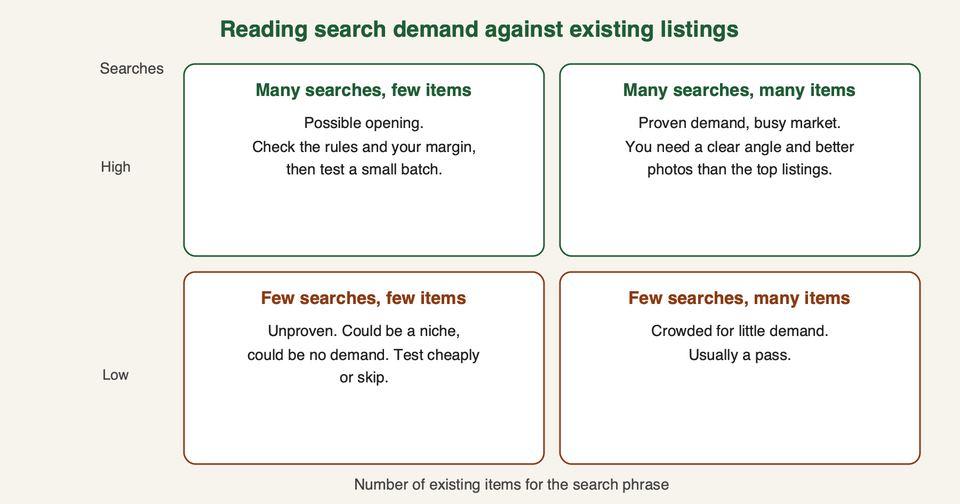
- Check search interest and item count together. Marketplace Insights shows both. Many searches and few items can mean an opening. Many searches and many items usually means buyers are there but you need a clear angle.
- Look at quality, not just quantity. Open ten listings for the phrase. Are the photos sharp? Are there size guides and clear options? Weak listings in a busy term are an opening. Excellent listings are a warning.
- Check timing. Use the trend reports and Google Trends to see when interest rises, and plan to list before the peak.
- Work out your margin. Add your make or print cost, shipping, packaging, Etsy's current fees and expected returns. If the number is thin, the idea is not ready, however popular the search term.
- Start small. List a handful of items, and let real orders tell you more than any tool.
Pick this approach if you want a method you can repeat each season without paying for outside tools. Skip this approach if you need exact sales figures: Etsy does not share them for other sellers, and we found no honest way to get them.
When to take an idea to your own Shopify store
Etsy is a good place to test. Buyers are already there, and listings can go live quickly. But Etsy's Seller Policy limits what you can do with the buyers you get: you may not add a buyer to a mailing list without their consent, and buyer details can be used only for Etsy-related communication. Your own store gives you your own brand pages, your own customer list (with proper consent) and your own rules.
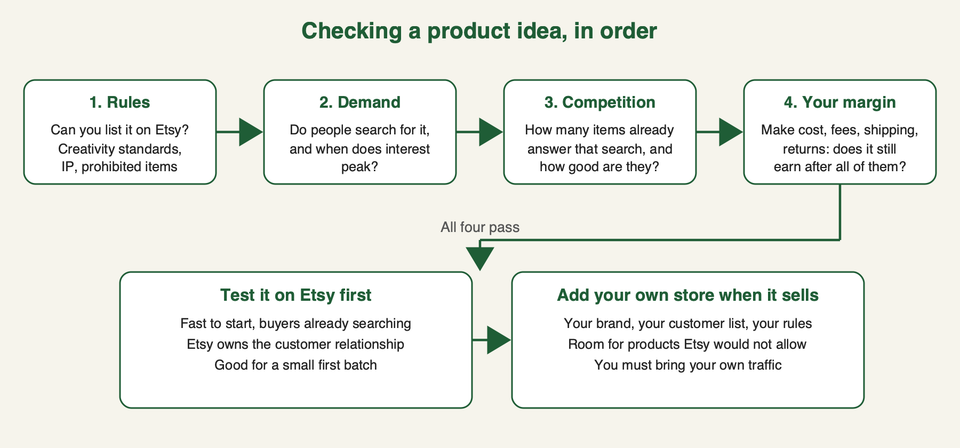
Move an idea to your own store when:
- The product sells steadily on Etsy and you have worked out the margin.
- You have repeat buyers, or want to build a brand beyond one marketplace.
- Your product does not fit Etsy's rules, for example a product you buy in rather than make or design.
- You are ready to bring your own traffic, because a new store has no built-in shoppers.
Stay on Etsy only if you mostly want its search traffic and are happy with its rules. If you are ready to build, our guide to setting up a Shopify store walks through it, and selling digital products on Shopify is a useful read if your idea is a download. If you would like an expert to review your plan, get in touch.
Questions people ask
What sells best on Etsy right now?
Etsy's latest seller trend reports point to handmade-looking items, craft kits, personalised gifts, table decor and vintage-style accessories. Those reports reflect search and sales data for a season, so they change. Read the current report for your category.
Is Marketplace Insights free?
Etsy's article says every shop gets a limited number of free searches each week, and that Etsy Plus subscribers get unlimited searches. Etsy also called the tool a beta, so details may change. Check Shop Manager for the current terms.
Can I sell print on demand products on Etsy?
Yes, if the design is your own and you disclose the production partner in the listing. Etsy's page on production partners lists print-on-demand services as an allowed type. See our Etsy print on demand guide.
Can I dropship on Etsy?
Etsy's Seller Policy says dropshipping and reselling are not allowed, apart from specific cases such as craft supplies. Buying finished items from a supplier and listing them as yours is the main thing to avoid.
Are AI-generated items allowed on Etsy?
Etsy's Creativity Standards allow creations generated from your own prompts, as long as you disclose AI use in the listing. They do not allow AI prompt bundles. Read the current standards before listing.
Can I use a famous character or brand name in my listing?
Only if you hold the rights. Etsy's Intellectual Property Policy makes sellers responsible for their content and removes listings after valid reports. A trending theme is not a licence.
Is Etsy or Shopify better for a new product?
They do different jobs. Etsy gives you buyers who are already searching, within Etsy's rules. Shopify gives you control of the brand and the customer relationship, but you bring the traffic. Many sellers test on Etsy, then add a store once a product proves itself.
Where can I check current Etsy rules?
Use Etsy's own policy pages linked above, because they change. The Seller Policy, Creativity Standards and Intellectual Property Policy are the three to read before you list.