Best T-Shirt Printing Companies for Shopify: 7 Compared
How DTG, screen printing, DTF and embroidery differ, and which t-shirt printers suit a Shopify store: five print-on-demand partners that connect to your store and two bulk printers, each with a pick this and skip this line.
The best t-shirt printer for your Shopify store depends on one question: do you want to hold stock, or print each order after it is paid? If you want no stock, pick an on-demand partner that connects to your store. If you already know a design will sell in volume, a bulk printer is usually cheaper per shirt. Below we explain the four printing methods in plain words, then compare seven companies we could verify on their own pages.
If the idea of on-demand is new to you, start with what print on demand is. If you want the Shopify app angle, our print on demand app guide goes deeper on the apps themselves.
How a t-shirt gets printed: four methods
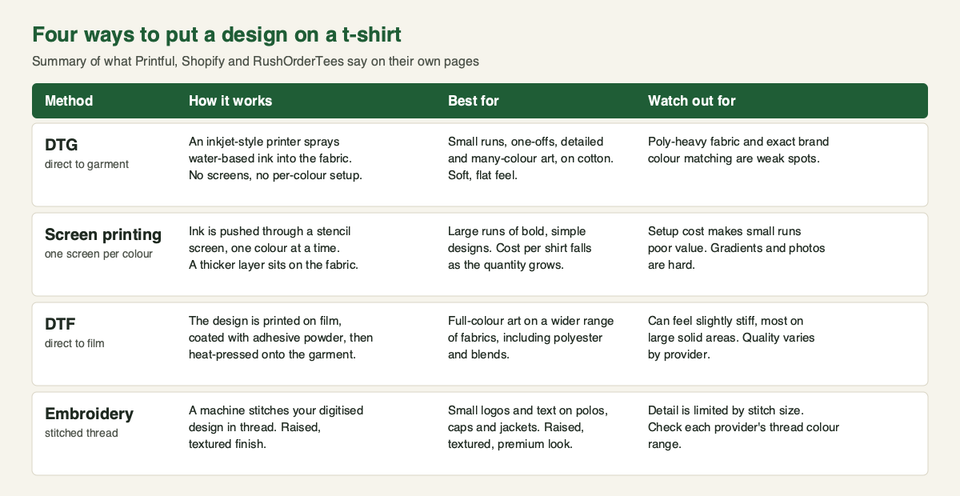
Most of the quality differences you will see between providers come from the method, not the brand name. Here are the four you will meet.
DTG (direct to garment)
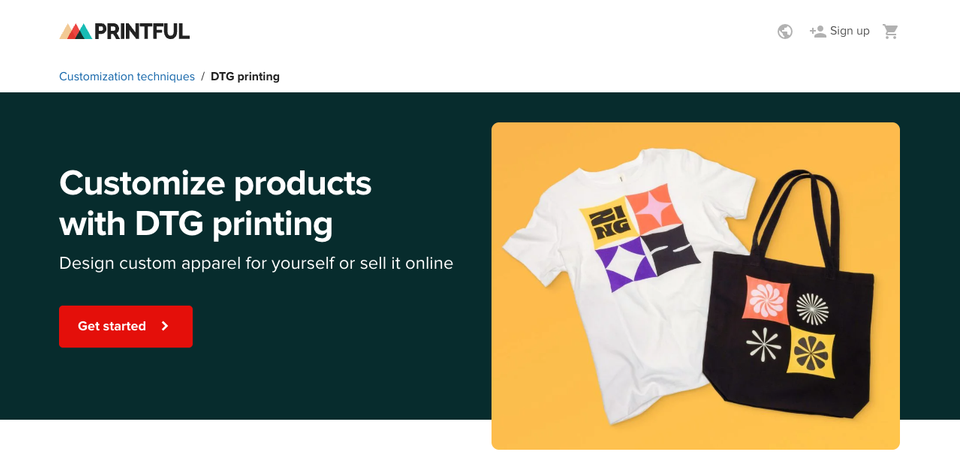
A printer applies water-based ink straight onto the shirt, much like an office inkjet. Printful's own guide says DTG suits small batches and detailed, multi-colour prints, with no setup cost and no extra charge per colour. It also says DTG ink bonds with natural fibres, so it works best on cotton and cotton-rich fabrics, and that polyester-heavy blends are a weak spot because dye can migrate into the print. Its DTG page puts the floor at fabric that is at least 50% cotton. Printful sells DTG itself, so read its durability and starter-method advice as a vendor view. The feel is soft, because the ink sits in the fibres rather than on top. Read the detail in Printful's DTG versus screen printing guide and its DTG page.
Screen printing
Each colour in your design gets its own stencil screen, and ink is pushed through one colour at a time. Printful's guide explains that the setup is paid for before anything prints, so the cost per shirt only drops once the run is large. It suits bold designs with few colours, and the thicker ink sits on the surface, which Printful says tends to outlast DTG under heavy washing. Gradients, photos and thin lines are hard. This is why screen printing is a bulk-run method, and why on-demand shops rarely use it.
DTF (direct to film)
The design is printed onto a special film, coated with adhesive powder, then heat-pressed onto the garment. Shopify's DTG versus DTF guide says DTF works on a wider range of fabrics, including synthetics like nylon and fleece, and produces vibrant colour. It also says DTF can feel slightly stiff or plasticky, especially with large solid areas, while DTG is softer. Printful sells its own take on DTF under the name DTFlex and says it avoids a visible glue layer on its DTF page. That is a vendor claim, so judge it on a sample.
Embroidery
A machine stitches your digitised design in thread. Printful's embroidery versus screen printing guide says embroidery gives a raised, textured, premium look and points to small logos and text as its best use. Embroidery works in thread, so detail is limited by stitch size. Printful says it offers unlimited thread colours, so ask any other provider about its range. Caps, polos and jackets are the usual products, and a left-chest logo on a tee also works.
Small runs versus large runs
- Small or uncertain runs: DTG or DTF, because there are no screens to pay for. Both are normal at on-demand partners.
- Large runs of one simple design: screen printing, because the setup cost is spread across many shirts.
- Small logo, premium feel: embroidery, at either scale.
Print files matter too. Each provider publishes its own file rules in its design tool, so read them before you upload. If you need to resize artwork first, our image resizer guide covers the tools.
Two kinds of printer, and how to choose
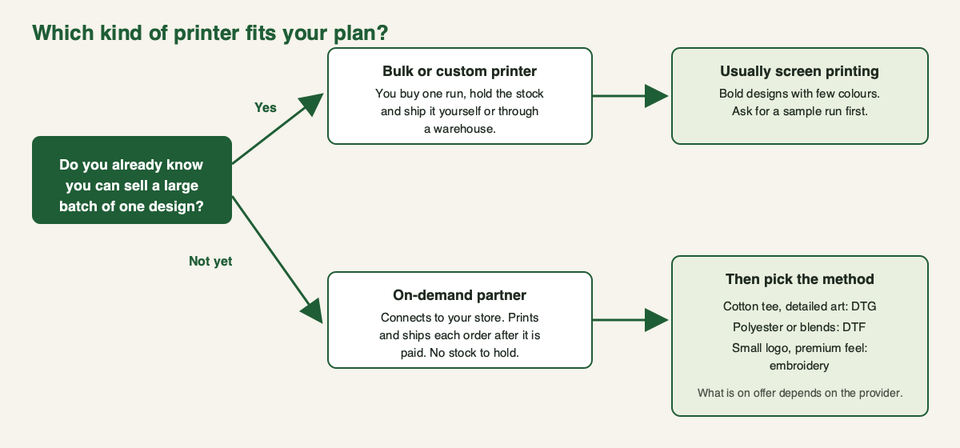
An on-demand partner connects to your store, prints each order after the customer pays, and ships it to them. You hold no stock. A bulk or custom printer prints a run you order and pay for up front. You then hold the shirts and ship them yourself or through a warehouse. If you sell creator merch and are moving away from a campaign platform, our Teespring alternatives guide covers that case.
Quick comparison of the seven companies below. Everything in the table comes from the provider's own pages or its Shopify App Store listing.
| Company | Model | Methods named on its pages | Store connection | Branding options listed |
|---|---|---|---|---|
| Printful | On demand | DTG, DTF (DTFlex), embroidery | Shopify app | Private labels, custom packaging, pack-ins |
| Printify | On demand, network of print providers | Apparel, embroidery listed | Shopify app | White label shipping, pack-ins |
| Gelato | On demand, local hubs | Apparel, embroidery listed | Shopify app | Private labels, custom packaging |
| Gooten | On demand, vetted decorators | Apparel, embroidery listed | Shopify app | Private labels, custom packaging, pack-ins |
| Apliiq | On demand, plus screen printing at volume | DTF, DTG, embroidery, screen printing | Shopify app | Private labels, neck prints, patches, custom packaging |
| RushOrderTees | Bulk or custom | Screen printing, embroidery, DTF, DTG | None found | Not stated |
| Custom Ink | Bulk or custom | Screen printing, digital printing, embroidery | None found | Not stated |
The Gelato and Gooten listings do not name "Shopify Admin" under "Works with". Both are listed in the Shopify App Store, and Gooten's own site tells you to install its app from there.
On-demand partners that connect to Shopify
Printful
Printful describes itself as a print-on-demand supplier that prints, packs and ships your products. Its pages name DTG, DTF and embroidery for apparel, and its Shopify listing shows it is free to install and lists private labels, custom packaging and pack-ins. Its DTG page says you can add your logo to garment labels and use custom packaging. The listing names sourcing locations in the United States, Canada, Mexico, Spain, Latvia, Japan and Australia, and the Printful home page says it ships around the world.
- Pick this if: you want one company to make, pack and ship, with embroidery and DTF available alongside DTG, and you want branding options such as labels and packing slips.
- Skip this if: you want to compare several print shops on the same product. Printful is a single supplier, so a sample order is your only way to judge it against others.
Printify
Printify's Shopify listing describes a network of print providers, with a catalogue it puts at over 1,300 products. In that model you choose a print provider per product, so price, location and print quality can differ between items. The listing shows white label shipping and pack-ins, and sourcing locations in the United States, Canada, the United Kingdom, Germany, Czechia, Poland, Latvia and Australia. Its own website blocked our fetch, so everything here comes from the listing.
- Pick this if: you like choosing between print shops and want a wide catalogue of blanks, with some providers closer to your customers.
- Skip this if: you want one accountable company. Because different providers make different items, the same design can come out differently, so sample each product you plan to sell.
Gelato
Gelato's Shopify listing says it has 140+ local production hubs in 32 countries and more than 100 custom products. The idea is to print close to the customer. The listing shows private labels, custom packaging and a mockup generator, and its sourcing locations include the United States, Canada, the United Kingdom, Germany, France, Italy, Spain, Australia, Brazil, India and Japan, among others.
- Pick this if: your customers are spread across several countries and local production matters more to you than the widest apparel range.
- Skip this if: most of your customers are in one country already served by another provider. The local-hub advantage then shrinks, so compare a sample from each.
Gooten
Gooten's website and Shopify page describe a catalogue of 500+ products produced by vetted decorators, with orders routed across its network. Its App Store listing shows private labels, custom packaging, pack-ins and white label shipping, and apparel and embroidery among its product types. Its listing calls it a solution built for businesses looking to scale, and its site lists Enterprise, SMB and Start-up business sizes.
- Pick this if: you want a network that routes orders for you, expect to grow, and want branding options such as private labels.
- Skip this if: you want to be sure of the setup before you commit. We could not judge its support or reliability from its own pages, so run a sample order first.
Apliiq
Apliiq's Shopify listing calls its service retail-ready clothing on demand with no minimums, and says orders are fulfilled from both US coasts, aimed at North American stores. Its own site lists DTF, DTG and embroidery on demand with no minimum, and screen printing for larger runs with a stated minimum of 12 per colour. It also lists private labels, neck prints, patches and custom packaging. The listing's pitch is private label, with your brand and no wholesale tags.
- Pick this if: you want your shirts to look like a clothing brand, with labels and patches, you may later want a screen-printed run from the same supplier, and your customers are mostly in North America.
- Skip this if: you sell worldwide and want production hubs in several regions. The listing talks about two US coasts only.
Bulk and custom printers
These printers do not behave like on-demand partners. We did not find a Shopify connection on the pages we read, so the usual route is to order a run, receive the shirts, and ship from your own stock.
RushOrderTees
RushOrderTees has pages for screen printing and embroidery, and its services menu also lists direct to film and direct to garment, and samples. Its screen printing page says the typical minimum for screen printing is about 15 per unique colour, and that smaller runs may use a digital method instead. Its T-shirt page says you can order one shirt or a bulk quantity, and that artwork is reviewed before printing. The pages we read talk about customers nationwide, so check international shipping before you plan around it.
- Pick this if: you have a design that already sells and want a screen-printed run, or want embroidery for caps and polos, with a design tool to build your order.
- Skip this if: you want a no-stock model. You will hold the shirts and handle fulfilment.
Custom Ink
Custom Ink's T-shirt page says you can order one shirt or one thousand, that each design is reviewed by an artist, and that it matches your design to a method: screen printing for bulk, digital printing for detailed designs and small orders, and embroidery for a stitched finish. It is aimed at groups, events and companies, with group ordering and fundraisers. Its help centre has a question on getting a sample before you order. The page lists a Canada T-shirts collection, but we did not find a clear statement on international shipping.
- Pick this if: you want a guided process for a team, event or merch drop, with a design review.
- Skip this if: you want products to sync into Shopify and ship straight to your customers. That is not what this kind of printer is for.
A sample-order checklist
Never launch a shirt you have not held. Order the same design from two providers, ideally one on-demand and one bulk or a second on-demand, and compare.
- Use the same design file and the same size shirt. Otherwise you are comparing files, not printers.
- Check the print. Is it sharp at the edges? Do colours match your screen? Is there a visible glue layer or cracking? Does a dark shirt look washed out?
- Check the shirt. Weight, neck, seams, and how it feels against the skin. The blank matters as much as the print.
- Check the size. Measure a chest and length against the provider's size chart, then against a shirt you already own.
- Check the label and packaging. Is your brand label in the neck? Is the packing slip branded the way you set it up?
- Wash it. Wash a sample the way a customer would, following the care label, and look again. This is the only way to judge durability.
- Check shipping. Track the order to a real address in each market you sell to. Note the carrier, the speed and whether tracking reaches your customer.
- Read the returns and reprint policy. Find out who pays when a print is faulty, and how a customer claim works.
Take photos of each sample next to the others, and keep the notes. That is your evidence when you choose. If you want help wiring the winner into your store, or checking the product pages, get in touch.
Frequently asked questions
Which printing method is best for a new Shopify store?
Many new stores start with DTG on cotton through an on-demand partner, because you add designs without holding stock. Printful, which sells DTG, makes that case in its own guide, so treat it as a vendor view and judge the print on a sample. If you use polyester or blends, ask about DTF.
Is DTG or screen printing better?
Neither wins in general. DTG suits small batches and detailed art, and screen printing suits large runs of simple designs. Printful's guide says screen prints tend to outlast DTG under heavy, repeated washing, which is a vendor view, so wash a sample.
Does DTF last as long as DTG?
Shopify's guide says DTF is generally considered more durable on a wider range of fabrics, but that DTF can feel stiffer, especially with large solid areas. Both hold up with proper care. Wash a sample to see how a provider's version behaves.
Can I put my own label in the neck of the shirt?
Several providers list private labels or white label options, but availability can depend on the product and your plan. Printful's DTG page says you can add your logo to garment labels. Check the exact product before you promise it to customers.
Do I need to buy stock to use a bulk printer?
Yes. A bulk or custom printer produces a run you order and pay for, so you hold the shirts and ship them yourself. The pages we read for RushOrderTees and Custom Ink show no Shopify connection.
Why does the same design look different from two printers?
The method, the inks, the machine and the blank shirt all differ. Fabric content matters too: Printful says DTG works best on natural fibres. That is why the sample checklist above uses the same file and the same size.
Which providers cover the UK and EU?
The listings name UK and EU sourcing locations. Printify lists the United Kingdom, Germany, Czechia, Poland and Latvia. Gelato lists the United Kingdom, Germany, France, Italy and Spain, among others. Printful lists Spain and Latvia. Confirm shipping speeds with a sample to your own address.
Which companies did you leave out?
Any provider whose own pages we could not open. Printify and Gelato block automated fetches on their main sites, so for those two we used their Shopify App Store listings only.