Print on Demand for Shopify: How It Works and Which App to Use
What print on demand is, how it works on a Shopify store, and seven POD apps and providers compared for artists, apparel brands and home goods sellers, with a checklist for samples, quality and shipping.

Print on demand (POD) lets you sell products with your own design on them without buying stock. A partner prints each item after the customer pays, packs it and ships it. This guide explains how that works on Shopify, compares seven providers, and tells you which kind of seller each one suits. The short answer: pick by what you sell and where your buyers live, then order samples before you publish anything.
What print on demand is
With normal retail you buy stock, store it, and hope it sells. With POD the stock is a blank item at your provider's site: a plain t-shirt, mug, canvas or tote. Nothing is printed until someone buys.
You supply the design and set the price. The provider supplies the blank, the printing machine, the packing and, usually, the shipping. You pay the provider for each order that sells.
That changes the risk. You do not tie up cash in unsold sizes, and you can test many designs cheaply. The trade-off is that each item costs you more than it would in a bulk print run, and you give up some control over speed and quality. POD suits testing ideas, art and personalised goods. It suits high-volume, low-price items less well.
How it works on Shopify
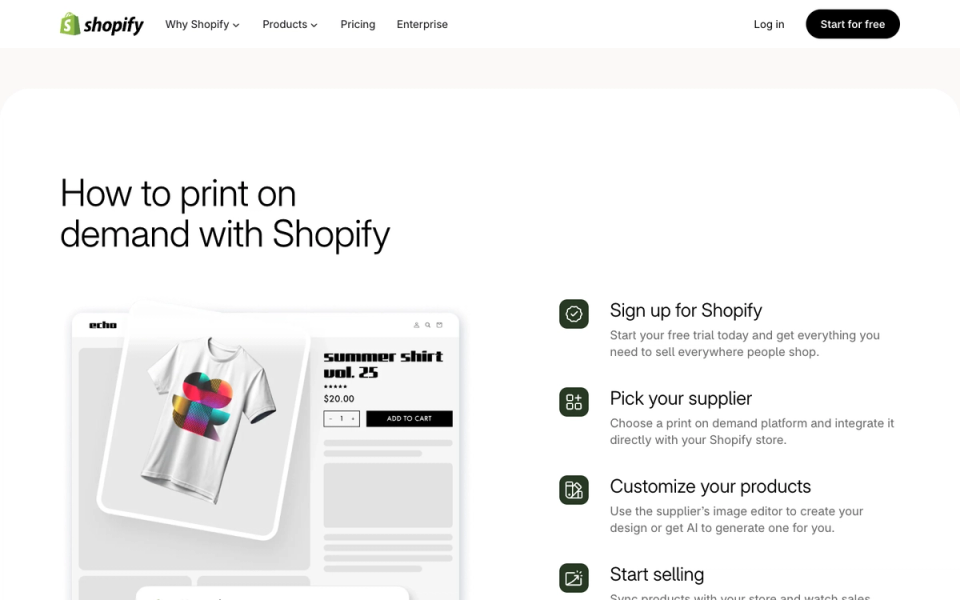
Shopify describes the setup in four steps on its print on demand page: sign up, pick a supplier and connect it, create your products in the supplier's design tool, then sync them to your store and start selling. Orders go from the supplier to your customer, so there is no inventory on your side.
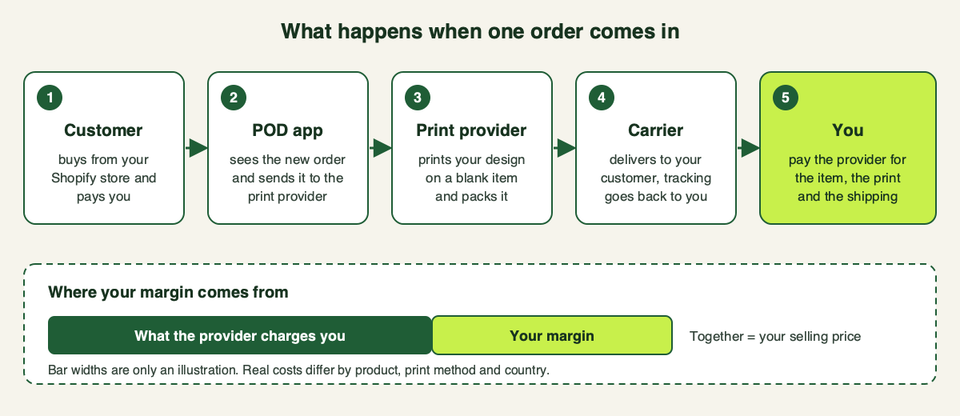
In practice, the app does four jobs:
- It lets you create a product (a design on a blank) and publishes it to your store as a normal Shopify product.
- It watches for new orders and sends the matching ones to the print provider.
- It sends tracking back so your customer gets the usual shipping email.
- It bills you for each order it fulfils.
These apps ask for access to products, orders and customer data, because they must read orders and write products. The permissions are listed on each App Store page. Read them before you install, as you would with any app.
One more point. Some "apps" are really a provider with a Shopify connector. Prodigi, for example, describes connecting from inside its own dashboard rather than from an App Store install. We cover that below.
The seven providers we checked
We opened each App Store listing and, where it helped, the vendor's own site. Listings change, so treat the lists below as a snapshot and re-read the current page before you commit. We have not placed test orders with these providers, so what follows is what they publish, plus our view on who it suits.
Printful
Printful's listing is free to install and lists clothing and accessories, bags, home and garden, baby, sports and pet products. Product types include all-over print, embroidery, hats, shoes, drinkware, wall art and blankets. It lists production in the United States, Canada, Mexico, Spain, Latvia, Japan and Australia.
Branding is a strength on paper: custom packaging, pack-ins and packing slips are listed, and Printful's quality page describes white-label packaging. The same page says it runs a three-step quality check and says plainly that it is not the cheapest option. Its shipping page says it takes 2 to 5 business days to create and fulfil an order before shipping starts, and calls delivery times estimates, not guarantees. The listing mentions discounted sample orders on the free plan, and a paid plan that trades a monthly fee for lower product prices.
Pick this if you want one producer for a broad catalogue, especially apparel and embroidery, and you care about branding extras. Watch for higher base prices than some rivals, and read recent reviews on mockups, which one merchant on the listing found confusing.
Printify
Printify works differently. It is a marketplace: you choose from a network of independent print providers in several countries, and Printify routes and monitors the orders. The listing shows providers in the United States, Canada, the United Kingdom, Germany, Czechia, Poland, Latvia and Australia. The free plan includes manual order creation, which is handy for samples. A paid plan trades a monthly fee for product discounts.
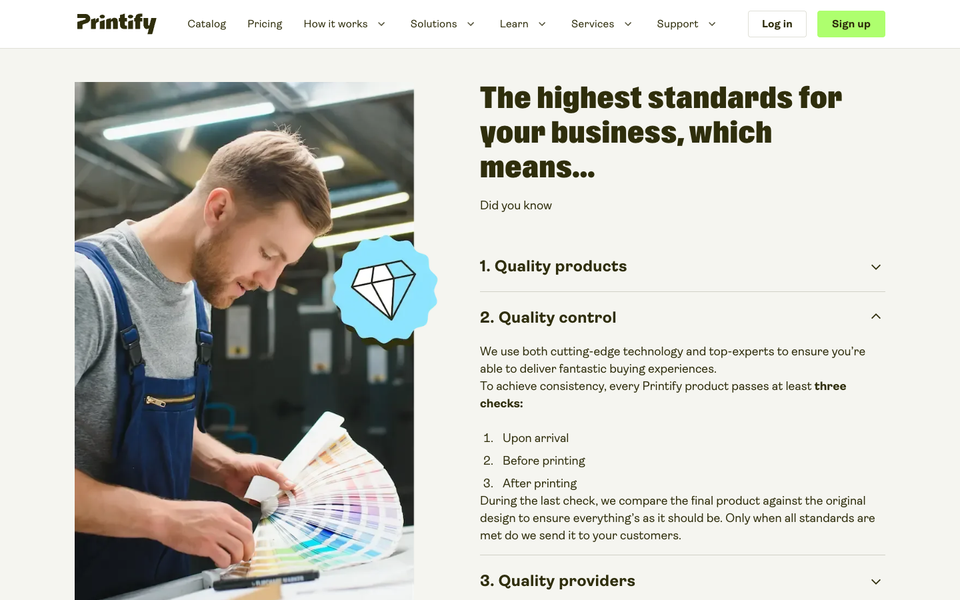
Printify's quality page says every product passes checks on arrival, before printing and after printing, and that it scores and can limit providers who fall short. Its merchant protection page promises a reprint if an item arrives printed wrongly or damaged, with a refund route if the reprint also fails.
Branding needs care. Its custom branding page says neck labels and packing inserts work only with some print providers, that insert orders are not re-routed to another provider, and that express shipping does not support them. Also, Printify's own pages quote different catalogue sizes (the App Store text, its how-it-works page and Shopify's page do not agree), so ask for the exact product you want rather than trusting a headline number.
Pick this if you like choice and are willing to compare providers product by product. Watch for quality and speed varying by provider, and branding options that depend on which one you pick.
Gelato
Gelato is built around local production. The listing says it has 140+ production hubs in 32 countries, so an order can be made near the buyer. That should cut shipping distance and, in principle, delivery time and cost. Listed products include apparel, bags, hats, drinkware, home decor and wall art, with private label and custom packaging options. The listing shows a free plan where you pay for what you print, and a paid plan with a free trial.
Pick this if your buyers are spread across several countries, especially in Europe, and you sell wall art and home goods. Watch for support: some recent merchant reviews on the listing complain about it and about file checks, so read the latest ones, not only the average.
Prodigi
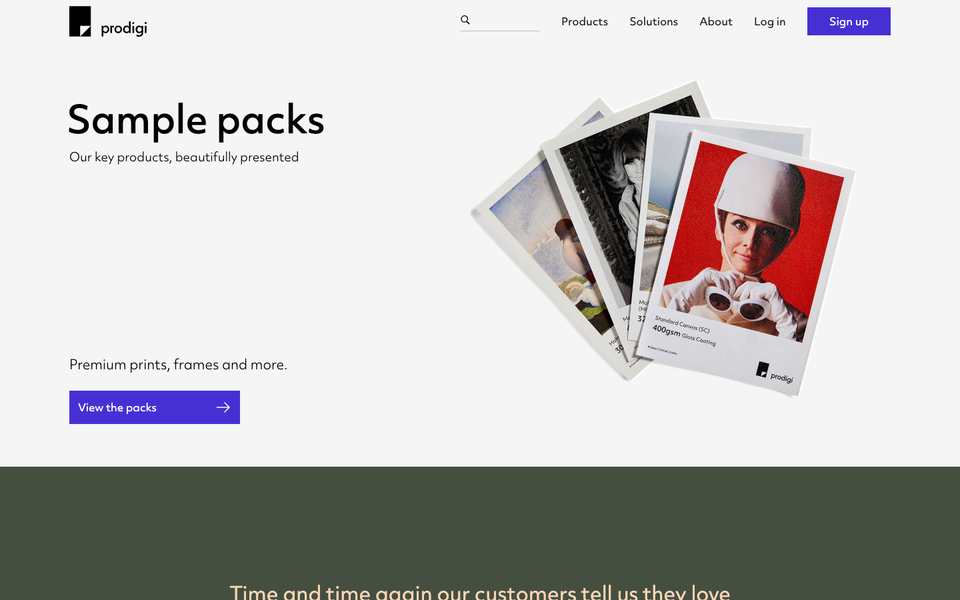
Prodigi is the one to look at if you sell art. Its catalogue leans to fine art prints, stretched canvas, framed prints, gallery boards, cards, notebooks and cushions, plus apparel. It says it prints in its own facilities in the UK, EU and US and also uses partner printers, and that its system routes each order to the nearest site. Its Shopify page says you connect from the Sales channels area of your Prodigi dashboard, then wait for an email, and that you can store artwork for automatic fulfilment or leave it blank to review each order.
It also sells sample packs of its papers, canvases and frames, so you can see and feel the materials before you list anything.
Pick this if you are an artist, illustrator or photographer selling prints. Watch for the setup: we did not find a Prodigi listing when we searched the Shopify App Store, so the usual one-click install and public App Store reviews may not apply. Its own pages also give different partner counts (50+ suppliers on one page, 100+ on another), so ask what applies to your country.
Inkthreadable
Inkthreadable is a UK producer. Its listing says it prints and embroiders apparel and homeware in the UK, ships worldwide from there, and offers custom neck labels, packing slips, sustainable apparel options and plastic-free packaging. It says there is no subscription or paid tier, and tells you to order samples first.
Pick this if you are a UK or EU brand that wants UK production and small, branded runs. Watch for international shipping on every order outside the UK, and a small review base compared with the big names, which means less evidence either way.
Apliiq
Apliiq is aimed at clothing brands. The listing talks about retail-ready apparel, no minimums, private label ("only your brand, no wholesale tags"), custom packaging and pack-ins, and US-based support. It lists sourcing in the United States and says orders ship from both coasts, which suits North American stores. It has a free tier where you are charged only for orders it fulfils, and a paid plan with product discounts. The listing warns that charges may be billed separately from your Shopify invoice.
Pick this if you are building a US-based apparel brand and want a retail look. Watch for its US-only production and clothing focus.
CustomCat
CustomCat is a US printer. The listing says items are printed and shipped from the USA, and mentions tools to publish many listings at once. It lists apparel, drinkware, bags, blankets, hats, home decor and wall art, and works with personalisation apps. It has a free plan, and a paid plan with a trial. As with Apliiq, charges may be billed separately from Shopify.
Pick this if you sell mostly in the US and want US-only production for t-shirts and drinkware. Watch for personalisation: it relies on separate apps, so test that flow end to end.
Two more we looked at and set aside
- Lulu Direct prints and ships books, with a very wide range of formats listed. If you sell books or zines, look at it. It is not a general POD provider.
Side-by-side
This is a summary of what each provider states, not a ranking. Re-check each row on the current listing.
| Provider | Model | Production sites as listed | Branding as listed | Samples |
|---|---|---|---|---|
| Printful | In-house producer | US, Canada, Mexico, Spain, Latvia, Japan, Australia | Custom packaging, pack-ins, packing slips | Discounted sample orders mentioned |
| Printify | Network of providers | US, Canada, UK, Germany, Czechia, Poland, Latvia, Australia | Neck labels and inserts, some providers only | Manual orders on the free plan |
| Gelato | Local production network | 32 countries per the listing | Private label, custom packaging | Check the provider |
| Prodigi | In-house plus partners | UK, EU, US, plus partners | Branded inserts offered | Physical sample packs |
| Inkthreadable | UK producer | UK | Neck labels, packing slips | Listing says order samples first |
| Apliiq | US apparel producer | US | Private label, packaging, pack-ins | Check the provider |
| CustomCat | US producer | US | White-label shipping listed | Check the provider |
How to choose
Start with what you sell. Then look at where your buyers live, and only then compare extras.
For artists
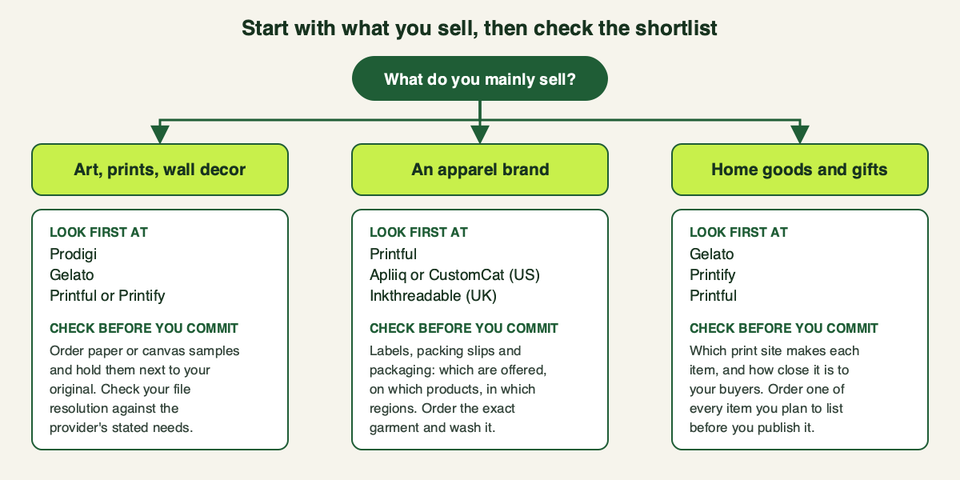
You are selling reproduction of an original, so paper, canvas and frame quality matter most. Start with Prodigi and Gelato, then compare Printful or Printify for wall art. Order sample packs or a print of your own best piece, and hold it beside the original. Check the minimum file resolution for each product before you upload. Artists also tend to sell a limited range, so a provider with a narrower but better catalogue is fine.
For apparel brands
Here the garment and the finish decide repeat sales. Printful, Apliiq, CustomCat and Inkthreadable are all clothing-led. Ask about neck labels, packing slips and packaging, and which products and regions those cover. Order the exact garment in the colours you plan to sell, wash it, and check the print afterwards. If you want a branded unboxing, confirm in writing that the option works for the product and country you sell in.
For home goods and gifts
Mugs, cushions, cards and posters are cheap to ship but easy to get wrong. Gelato, Printify and Printful all list home decor. Check which print site makes each item and how far it is from your buyers, because a mug made across an ocean costs more to send. Order one of every item you plan to list.
Margins, without the maths
We do not quote prices here because they change and differ by product, size and country. Think about margin like this:
- What you pay per order: the blank item, the printing and the shipping. The provider charges all three each time you sell.
- What you also pay: Shopify's plan, payment fees (see does Shopify take a percentage of sales), any app plan, ads, discounts, and the cost of the occasional return or reprint.
- Paid app tiers on Printful, Printify, Gelato, Apliiq and CustomCat trade a monthly fee for lower product prices. They only pay off at enough orders. Work out the break-even from the provider's current price sheet for your real products.
- Shipping is a design choice. Printful's page notes you set your own shipping rates in your store. You can charge it, or raise product prices and offer free shipping, which is explained in our guide to free shipping on Shopify.
Shopify's POD page has a profit calculator, but its own footnote says the figures leave out shipping, taxes and other costs. Treat it as a rough sketch.
Quality control: order samples first
The biggest risk in POD is a product you have never seen. Before you publish a design:
- Order one sample of each product type. For apparel, order the colours and sizes you will sell.
- Compare the print with your design on a calibrated screen and in daylight. Look at placement, edge sharpness and colour.
- Wash and wear a garment. Look at the fabric, the neckline and the print after washing.
- Photograph your sample. Real photos show customers what they will actually get, and they stop you listing something you have not seen.
- Read the provider's reprint and returns policy and note what proof it asks for, usually photos.
Providers help here. Printify publishes its quality checks and reprint policy, and Prodigi sells sample packs. No provider removes the need to look for yourself.
Shipping times: what to promise
There are two clocks. The first is production: Printful says it takes 2 to 5 business days to create and fulfil an order. The second is the carrier. Printful describes its delivery times as estimates, and says they do not include production time. Other providers publish their own figures, so check the product page for the exact item.
So do not promise a date you do not control. Put an honest range on the product page and in your shipping policy. Mention that a mixed order can arrive in more than one parcel, because items may be made at different sites. Printful's shipping page has a section on products that ship separately. For international orders, ask the provider who handles duties and customs. Our Shopify launch checklist includes shipping and policy pages worth finishing before you open.
Before you install, check this
- The listing's current pricing: is billing through Shopify, or can the vendor bill you separately?
- The permissions screen.
- Where your top three products would be made, and how that compares with where your buyers are.
- Whether the branding you want (labels, inserts, packing slips) works on those products.
- The sample route and the reprint policy.
- The most recent one-star and three-star reviews, not just the average.
- If you plan to use the same design across several apps, how the products will be named so you can tell them apart.
If you would rather not do the setup alone, such as theme changes for product pages, shipping rules and tidy product data, talk to us and tell us what you sell. We can help you pick and wire it.
FAQ
What is print on demand in simple terms?
It means your product is made after someone buys it. You supply the design and set the price. A partner prints, packs and ships the item. You pay the partner per order, not up front.
Is print on demand free to start on Shopify?
The App Store listings above say free to install, and several have a free plan, so you usually pay when a sale happens. You still need a Shopify plan, and you should budget for samples. Some apps also have paid tiers with lower product prices. See our guide to Shopify dropshipping apps for related options.
Can customers tell I use print on demand?
It depends on the provider and product. Printful, Printify, Apliiq, Inkthreadable and Prodigi list branding options such as packing slips, labels or inserts, but the options vary by product and region. Ask for the exact items you plan to sell, then confirm with a sample.
Printful or Printify?
Printful makes the product itself and states it controls quality end to end. Printify routes your order to one of many independent providers, so you get more choice but also more variation. If you want one consistent producer, start with Printful. If you want to shop around by product, look at Printify. Order the same design from each and compare.
Do I really need to order samples?
Yes. Prodigi sells sample packs, Printful's listing mentions discounted sample orders, Inkthreadable's listing tells you to order samples first, and Printify's free plan lets you create manual orders. Whichever you pick, a sample shows you print quality, colour, sizing and packaging before a customer does.
What about taxes, duties and returns?
Each provider has its own rules and they differ by country. Prodigi and Printful both list tax or customs questions in their FAQs. Read them for the countries you sell to, and ask an accountant about your own tax position. For returns, most POD items are made to order, so check what the provider covers, usually errors and damage, and write your store policy to match.
Can I use more than one provider?
Nothing in the listings we read forbids it, and many sellers try two providers on different products. Keep product titles and tags clear so you know which provider makes what, and check each app's listing for any limits.
Can I sell books with print on demand?
Yes, with a book printer rather than a general POD provider. Lulu Direct's listing says it prints and ships books to your customers and lists a wide range of formats. Check its current terms before you build a catalogue.