ChatGPT Wallet: What OpenAI's Agent Checkout Means for Shopify Stores
ChatGPT Wallet lets OpenAI's dots agents pay on a store's own checkout with a one-purchase card token after the shopper approves. Here is who can use it, how a purchase works and what Shopify stores should check now.


ChatGPT Wallet lets agents pay on your own checkout
Generated by Ecompanda AI
ChatGPT Wallet lets OpenAI's dots agents buy on a shopper's behalf, using a card token after the shopper approves each purchase. OpenAI says it works on existing checkout pages with no Wallet-specific integration, so your Shopify checkout, stock and fraud rules decide whether the sale completes.
- Rolling out to a limited number of US ChatGPT Pro users aged 18 or over
- The agent pays on your existing checkout with a network token, never the real card number
- You still handle the order, fulfilment, support and fraud decisions
- Bot rules and fraud tools can block legitimate agent purchases
- Order labelling, chargeback handling and wider rollout are not yet documented
ChatGPT Wallet lets OpenAI's agents pay for things on a shopper's behalf. It launched on 13 November 2026 for a small group of US users. For a Shopify store, what matters is where the purchase happens: on your own checkout, filled in by the agent's browser with a one-purchase card token.
What is ChatGPT Wallet?
ChatGPT Wallet is a payment feature in ChatGPT that lets a user's agent pay for a purchase with a card token issued by the payment network, after the user has approved the items, the total and the card. OpenAI built it with American Express, Mastercard and Visa, The Next Web reported.
The agents are called dots. OpenAI's own documentation describes a dot as an always-on agent that "lives in the cloud and has its own computer and browser". That browser is what visits your store. Wallet is the piece that lets it pay.
Two business details from launch coverage: OpenAI is not taking a cut of purchases for now, CNBC reported (as relayed by The Next Web), and OpenAI says it plans to let users set spending limits, purchase categories or time periods later, so an agent could buy within those rules with less hands-on approval (TechCrunch). Neither has a date.
Who can use ChatGPT Wallet today?
Very few shoppers so far. At launch it is limited to some US ChatGPT Pro subscribers aged 18 or over, with an eligible US-issued card. OpenAI said it is starting small to learn from real use and to work with businesses, banks and payment networks on compatibility, 9to5Mac reported.
| Item | What was announced or reported |
|---|---|
| Plan | ChatGPT Pro, limited number of users at first |
| Country | United States, with a US billing address |
| Age | 18 or older |
| Cards | Eligible US-issued Visa, Mastercard or American Express (some outlets also list Chase) |
| Where it works | Only in conversations with a dot, not in ordinary chat, Work or standalone Codex |
| Merchant setup | No Wallet-specific integration required, per OpenAI's merchant guide |
| Coverage | OpenAI says not every merchant, device or card is supported |
Sources for the table: plan, age and card brands from TechCrunch; Chase from GSMArena; billing address, the dots-only rule and the coverage line from Stocktwits on Yahoo, which cites OpenAI; the merchant line from OpenAI's Accept payments guide.
For UK and EU stores, the buyers are the limit. Wallet's users are US shoppers with US cards, so it matters to you only if you already sell to the US.
How does an agent purchase with ChatGPT Wallet work?
The short version: the dot shops your site like a person would, the shopper approves in ChatGPT, the card network issues a token, and your checkout charges that token like any card. Here is each step, using only what OpenAI and the outlets quoting it describe.
- The shopper adds an eligible card to ChatGPT Wallet once (TechCrunch).
- The shopper asks their dot to find and buy something. OpenAI's partner playbook overview says ChatGPT can draw on the public web, private integrations and, for retail, merchant product feeds.
- The purchase moves to browser use or a plugin. OpenAI's overview says browser use follows your existing website flow: ChatGPT's cloud browser reads pages, clicks buttons and fills forms (OpenAI Agent Access).
- The dot supplies what the order needs, such as the shipping address and contact details (TechCrunch).
- Before paying, the shopper reviews the items, the total and the card, then approves with a check such as Face ID or a fingerprint. Each approval creates a record of what the shopper allowed (9to5Mac).
- The payment network then provides a token with its own card number, security code and expiry date, standing in for the real card (9to5Mac).
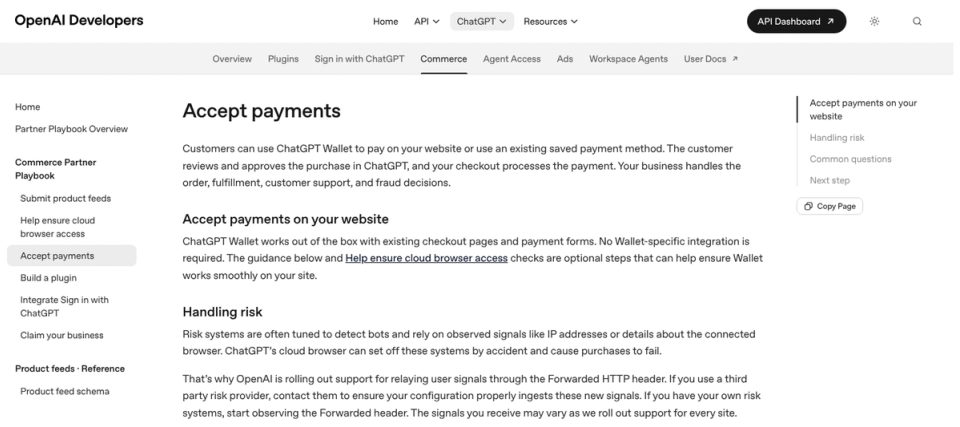
- Your checkout processes the payment. You receive a network token, not the full card number, and OpenAI says you can use the Payment Account Reference (PAR) to link the token to the underlying account (Accept payments).
- Your business handles the order, fulfilment, customer support and fraud decisions, as with any other order (Accept payments).
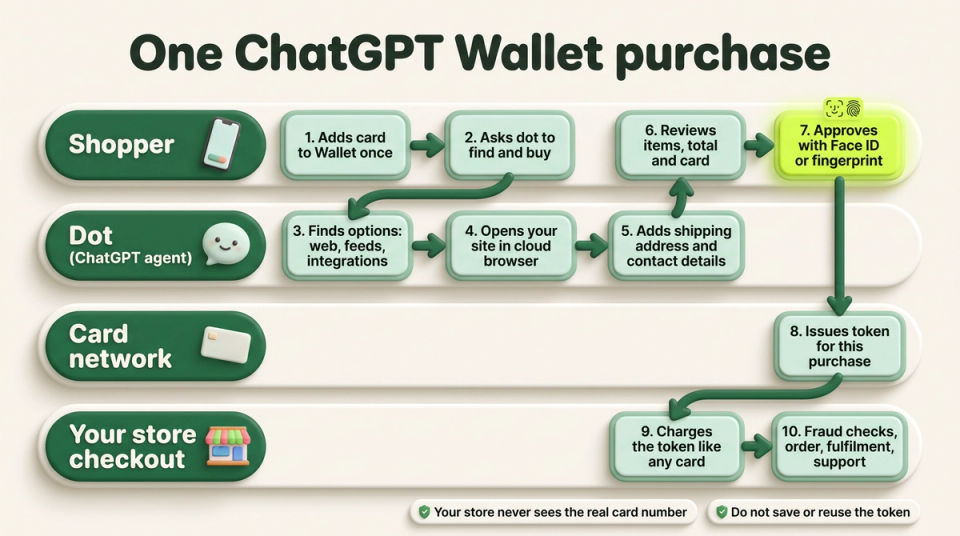
Three rules in OpenAI's merchant guide are worth knowing. The token covers that one purchase, so you must not save or reuse it. Subscriptions are allowed if your checkout already supports recurring billing and you get the customer's consent. And a card the customer already saved with you keeps working; Wallet is a separate payment option.
Does ChatGPT Wallet use the Agentic Commerce Protocol?
We cannot tell. OpenAI's Wallet pages for merchants do not mention ACP, and accepting Wallet needs no ACP work. But OpenAI's developer index still files these pages under "Agentic Commerce Protocol". The Wallet path they describe is a card network token used on your existing checkout. ACP is still published by Stripe and OpenAI at agenticcommerce.dev, and it is date-versioned and still changing, so treat any vendor that sells "ACP compliance" for Wallet with care. For plugins, OpenAI says it is "still working on the interaction patterns between third-party plugins and ChatGPT Wallet".
How is ChatGPT Wallet different from Instant Checkout?
Instant Checkout put a checkout inside the chat. Wallet sends the agent to your checkout. That is the whole difference in one line, and it changes what you control.
Stripe's announcement from 29 September 2025 describes Instant Checkout: US ChatGPT users could buy from US Etsy sellers, with Shopify merchants "coming soon", through a Stripe-powered checkout shown inline in the chat. At launch, Stripe issued a Shared Payment Token, and orders flowed to the merchant's backend through ACP. Shopify's own pilot with OpenAI ran Instant Checkout on Shopify Payments, according to details Shopify shared with Modern Retail.
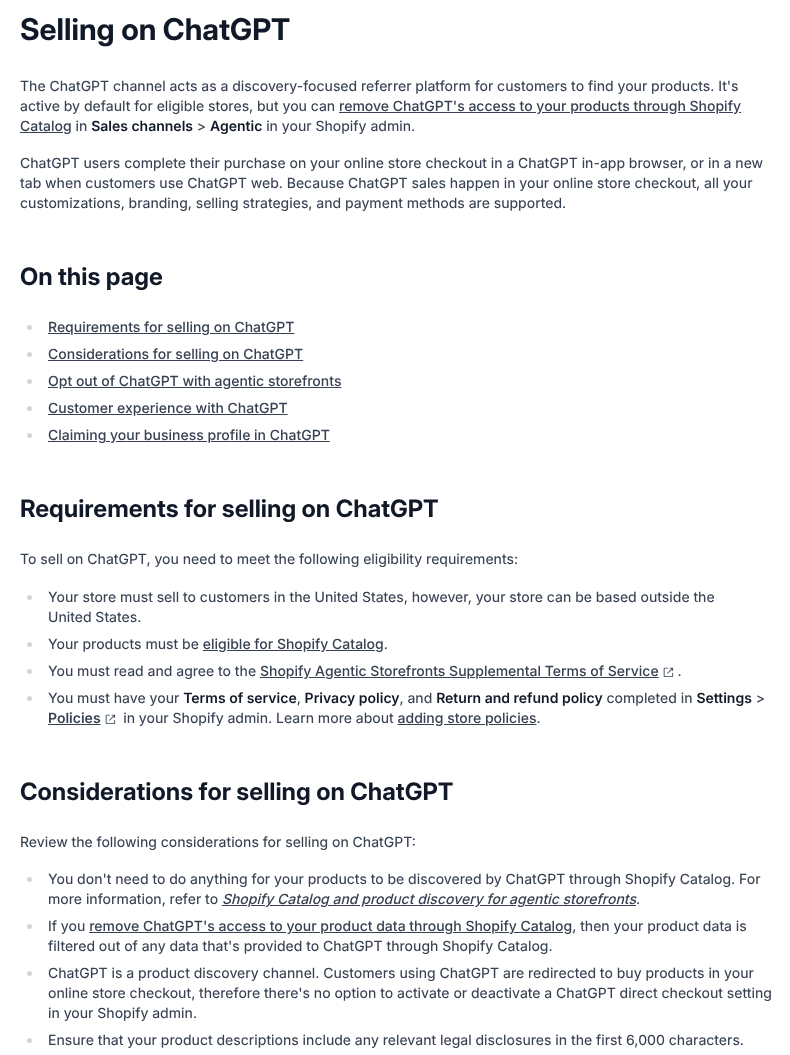
In March 2026 OpenAI moved away from that model. An OpenAI spokesperson told Modern Retail it was prioritising search and product discovery and that "Instant Checkout is moving to Apps". Shopify's own Selling on ChatGPT page now calls ChatGPT a discovery-focused referrer: shoppers complete the purchase on your online store checkout, in ChatGPT's in-app browser or a new tab.
| Question | Instant Checkout | Shopify ChatGPT channel | ChatGPT Wallet |
|---|---|---|---|
| Where payment happens | Checkout inside the chat (Stripe-powered at launch; Shopify Payments in Shopify's pilot) | Your online store checkout, in ChatGPT's in-app browser or a new tab | Your online store checkout, in the dot's cloud browser |
| Who enters payment | The buyer, in the chat | The shopper, with any method your checkout accepts | The dot, with a token, after the shopper approves |
| Merchant setup | Orders sent to the merchant through ACP | On by default for eligible stores | No Wallet-specific integration required |
| Status | OpenAI moved away from it | Live for eligible stores | Limited rollout to US Pro users |
So a ChatGPT shopper can now reach your Shopify checkout two ways: tapping a product link and paying themselves, or sending a dot to pay for them.
What does ChatGPT Wallet mean for a Shopify store?
OpenAI says Wallet needs no Wallet-specific integration on existing checkouts. It does not name Shopify, but we expect a Shopify checkout to need nothing installed. None of the Shopify pages we read mention ChatGPT Wallet or dots either, so how Shopify treats these visits and orders is not documented yet. What you do control is everything the agent reads and every rule it has to pass.
Product data. For discovery, Shopify says you do not need to build or maintain a product feed for ChatGPT: eligible products are already there through Shopify Catalog, with pricing and availability kept up to date (Selling on ChatGPT). The same page asks you to put any relevant legal disclosures in the first 6,000 characters of a product description. Shopify's agentic storefronts settings page checks variant and option names for acronyms or numbers that agents find hard to understand. If key facts live in custom fields, our guide to Shopify metafields explains where that data sits.
Policies. To sell on the ChatGPT channel you need your Terms of service, Privacy policy and Return and refund policy completed in Settings, and you must sell to US customers, though your store can be based elsewhere (Selling on ChatGPT).
Stock. A product can sell out between the recommendation and the checkout. Shopify checks inventory at checkout and suggests turning on inventory tracking and turning off "Continue selling when out of stock" for products that should stop at zero (Shopify blog).
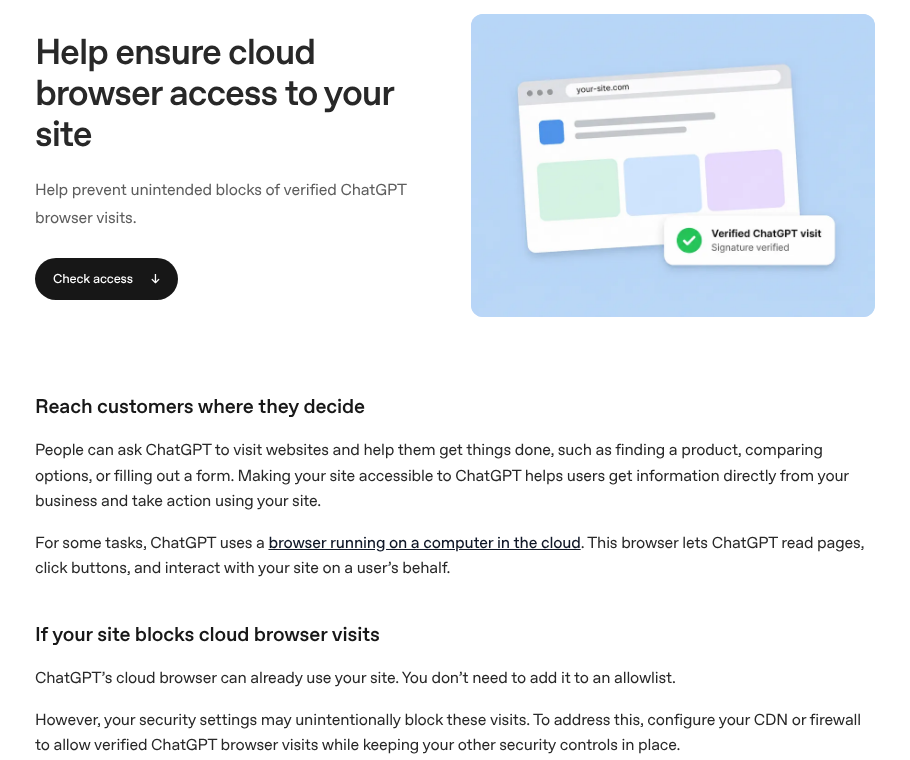
Bot access. The dot arrives as a signed cloud browser visit. OpenAI says the cloud browser can already use your site without an allowlist; the risk is security settings blocking it by accident. It says Akamai, Cloudflare, HUMAN and Vercel verify these signatures automatically and gives settings for each (Agent Access). Shopify is not on that list, and we found no Shopify page on how its own edge treats signed ChatGPT visits. A headless storefront behind one of those providers can follow OpenAI's steps directly.
Fraud tools. OpenAI warns that risk systems tuned to stop bots can make agent purchases fail, and it is rolling out user signals in the Forwarded HTTP header: country, locale, time zone and a masked IP prefix, and the header can also carry the full IP address observed for the shopper (for) and its network number, or ASN (asn) (Accept payments). If you use a fraud app, its vendor needs to read those.
Measurement. Shopify says orders from AI channels show channel or referrer attribution in your admin, and orders paid with Shop Pay through personal agents connected to Shop show attribution to the agent (agentic storefronts). Neither page says how a dot paying with Wallet will be labelled.
What should Shopify stores do this month?
Most of this is work you would do for any shopper, done more carefully. In order of value:
- Confirm you are in the ChatGPT channel. Open Sales channels > Agentic in your admin and check eligibility, your three policies and that you sell to the US.
- Fix product facts an agent will match against. Titles that name the variant, plain option names, materials, sizes, compatibility and disclosures early in the description. Our AI for ecommerce guide covers the wider picture.
- Make stock exact. Turn on inventory tracking and decide product by product whether overselling is allowed.
- Ask your fraud app vendor two questions. Does it read the
Forwardedheader signals OpenAI sends, and how does it score verified ChatGPT browser visits? - Check any layer you added in front of Shopify. If a headless build or a bot tool sits in front, use OpenAI's Agent Access steps so verified visits are not blocked.
- Brief support. OpenAI's answer on payment or order errors is to handle them as you would if the customer had taken the action themselves.
- Hold off on a plugin. OpenAI encourages plugins and says one "may make it easier and faster" for users to engage with your service (Agent Access). But it calls a plugin the option for teams with engineering resources (Build a plugin), and says its links with Wallet are still being worked out.
If you want a second pair of eyes on steps 2 to 5, our agentic commerce setup check looks at product data and mapping, policies, checkout compatibility and measurement on a Shopify store.
Skip most of this for now if you do not sell to the US, or if your checkout always needs a phone call, a quote or a custom form. Wallet's buyers are US shoppers, and an agent cannot finish a sale your checkout does not allow.
What are the risks and limits?
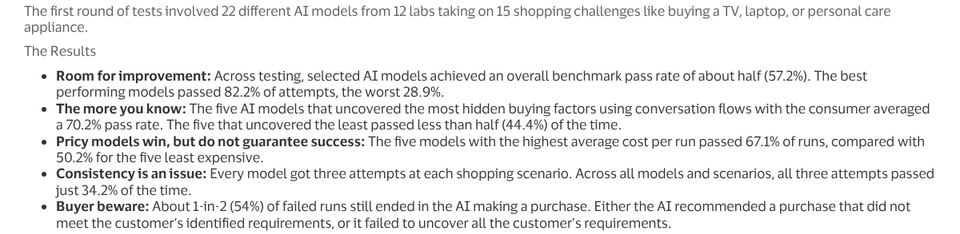
The biggest risk is an agent buying the wrong thing confidently. Visa's Agentic Commerce Benchmark, released on 5 November 2026, put 22 AI models from 12 labs through 15 shopping tasks. Models failed 42.8% of test runs, and about 54% of the failed runs still ended in a purchase. Every model got three attempts per task, and all three passed only 34.2% of the time.
Read those numbers carefully. Visa tested models on uncovering what a shopper needs and deciding whether to buy, not ChatGPT Wallet itself, and it says checkout, payment and order placement are not tested yet. Visa says the failed runs that still ended in a purchase came from agents that did not uncover all of the shopper's needs, or bought something that did not meet them. A store cannot fix the first, but once the agent knows the need, the product page must state the size, fit or compatibility fact it checks.
Other limits:
- Blocked or declined sales. OpenAI says some sites may block agent purchases by accident and risk systems may flag real ones, Help Net Security reported. Some big retailers block agents on purpose: CNBC reported that Amazon stops them buying on its platform (The Next Web).
- Returns and disputes. Shoppers keep their card's protections for eligible disputes, and businesses keep control of pricing, delivery, returns and service (The Next Web). Expect "my agent bought the wrong size" to arrive as a normal return.
- A small audience. A limited group of US Pro subscribers will not move most stores' numbers yet. Treat it as a test bed for agent readiness, not a sales channel.
What is still unknown about ChatGPT Wallet?
These are the questions OpenAI's merchant pages and Shopify's pages do not answer yet:
- Which merchants work. OpenAI says not every merchant is supported but, in the coverage we read, gives no list or test.
- How orders are labelled. We found nothing on how a Wallet order appears in Shopify's admin or reports.
- Chargebacks. Card protections carry over for shoppers, but we found no detail on how an agent purchase is handled in a dispute, or whether merchants can see the shopper's approval record.
- Merchant of record. The OpenAI merchant pages we read do not use the term. They say your checkout processes the payment and your business handles the order.
- Shopify's edge. We found no Shopify page on how its own bot protection treats signed ChatGPT browser visits.
- Expansion and fees. No dates for other countries, other plans or spending-limit purchases, and no word on fees after the current no-cut period.
FAQ
Do I need to integrate anything to accept ChatGPT Wallet?
No, according to OpenAI: Wallet works with existing checkout pages and needs no Wallet-specific integration. The optional steps, in the checklist above, are about not blocking the cloud browser and helping your fraud tools.
Will I see the shopper's card number?
No. You receive a one-purchase network token instead, as the purchase steps above explain.
Is ChatGPT Wallet the same as Instant Checkout?
No. Instant Checkout put a checkout inside the chat and OpenAI moved away from it in March 2026, while Wallet sends the agent to pay on your own checkout (see the comparison above).
Can UK or EU shoppers use ChatGPT Wallet?
Not at launch: it is limited to some US ChatGPT Pro subscribers with eligible US-issued cards. The eligibility table above has the details, and OpenAI has given no dates for other countries.
Can I stop agents from buying on my store?
Partly. In Shopify you can remove ChatGPT's access to your products through Shopify Catalog, but Shopify notes products can still be found through web crawling. The dot's cloud browser is a separate visitor that your bot and firewall rules decide on. OpenAI says site owners cannot yet control which actions users take, though it requires human review before any consequential action across all users (Agent Access).
Who handles returns from an agent purchase?
You do, under your normal policy, and OpenAI says to handle support as if the customer had acted themselves. The risks section above covers returns and disputes.
Does ChatGPT Wallet replace the ChatGPT channel in Shopify?
No. The Shopify ChatGPT channel is discovery: shoppers find products through Shopify Catalog and pay themselves on your checkout. Wallet is a way for an agent to pay. Both end on your checkout, so the same product data and policies serve both.
Your next step
Start with the first four items in the list above: confirm the ChatGPT channel, tidy the product facts on your top 20 sellers, make stock exact and send the two questions to your fraud app vendor. If you run a headless storefront or a bot tool in front of Shopify, or you want someone to test the full path from agent visit to paid order, talk to us.