AI Holiday Shopping 2026: The Data and a Black Friday Fix List
AI holiday shopping is growing fast from a small base, and most shoppers still buy on the store's own checkout. What Adobe, Shopify, Salesforce, Deloitte and Visa measured, and what a Shopify store should fix before Thanksgiving and Black Friday, in order.


AI drives holiday research; your own site closes the sale
Generated by Ecompanda AI
AI-referred visits to US retail sites are forecast to grow fast this holiday season, from a small base, and most AI shoppers still buy on the store's own checkout. Before Thanksgiving, fix the product facts, prices, stock and policies that assistants read, and start measuring AI referrals.
- Adobe forecasts AI traffic to US retail sites up 130% for 1 November to 31 December
- Shopify says AI traffic to its merchants is up 2.6x in Q3 and AI orders 3.3x, from a small base
- ChatGPT sends Shopify buyers to the store's own checkout
- Fix product facts, prices, stock and policies first
- Skip theme rebuilds and llms.txt apps this close to the peak
AI holiday shopping in 2026 is growing fast, but from a small base, and most of it still ends on the store's own website. Adobe forecasts a 130% rise in clicks from AI services to US retail sites from 1 November to 31 December. Separately, Shopify said on its Q3 call that AI traffic to its merchants was up 2.6x year over year, calling the volume "still small".
That makes the job before Thanksgiving (26 November), Black Friday (27 November) and Cyber Monday (30 November) concrete. Make sure what assistants read about your products and policies is correct, make sure the product page they send people to can close the sale, and measure the channel.
What the AI holiday shopping 2026 numbers measure
Each headline figure counts something different, so they cannot be stacked or compared. Growth is not share, a forecast is not a result, and a survey answer is not a purchase.
| Source | What it measures | Figure | What it means for a store |
|---|---|---|---|
| Adobe forecast | Growth in clicks from AI chat and browser services to US retail sites, 1 Nov to 31 Dec | Up 130% year over year | More AI visitors than last season, from a modest base |
| Adobe forecast, peak days | The same measure on single days | Thanksgiving up 159%, Black Friday up 95%, Cyber Monday up 88% | The biggest jump is on Thanksgiving |
| Adobe 2025 recap | The same measure for last season | Up 693.4% | A much lower growth rate this year, on a bigger base |
| Shopify Q3 call | AI traffic and orders to Shopify merchants, July to September vs a year earlier (call transcript) | Traffic 2.6x, orders 3.3x | Orders grew faster than visits |
| Salesforce prediction | Share of global holiday ecommerce traffic from AI chat agents, bots and scrapers included | 20% predicted | Some of it is bots, not buyers |
| Deloitte survey | What 4,000 US shoppers say they will do | 39% use AI as main tool for a task, 16% would let it buy | AI helps people decide, few let it pay |
| Visa benchmark | 22 AI models in controlled shopping tests | 42.8% of runs failed | Agents still miss what buyers need |
Adobe: growth in clicks, not a share of sales
Adobe's 2026 holiday forecast, published on 28 September, expects AI traffic to US retail sites to rise 130% year over year between 1 November and 31 December. Adobe counts a visit when a shopper clicks a link from an AI chat or browser service through to a retail site, and builds the forecast from Adobe Analytics data. The biggest jumps are expected on Thanksgiving (up 159%), Black Friday (up 95%) and Cyber Monday (up 88%).
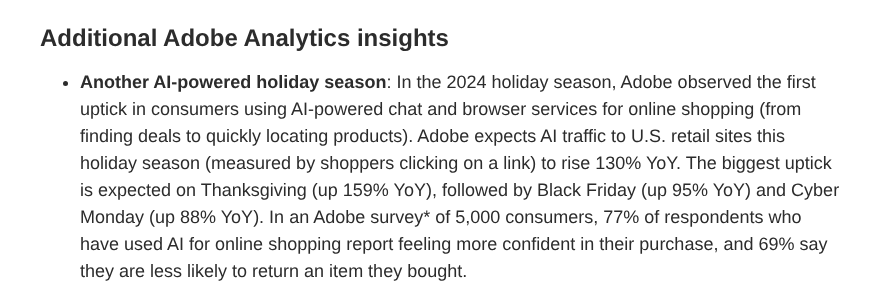
For scale, Adobe's recap of the 2025 season reported a 693.4% rise in the same kind of traffic and added that "the base of users remains modest". So this year's forecast is a much lower growth rate on a bigger base. We did not find AI's share of all retail visits in either release, so read the figures as growth, not size.
Shopify: orders growing faster than visits
On Shopify's third-quarter call on 3 November, president Harley Finkelstein said AI traffic to merchant stores was up 2.6x year over year and orders were growing faster, at 3.3x, while noting that "the volume is still small here". He also said AI channels send shoppers straight to product pages at 3x the rate of organic search, and that three quarters of AI-referred sales came from categories outside Shopify's top 100. We quote the call from The Motley Fool's transcript, as these figures are not in Shopify's Q3 press release, and we found no count of AI orders or their share of sales in either.
Salesforce: a share of traffic that includes bots
Salesforce's 2026 holiday predictions, published on 20 July with data from its global Shopping Index, forecast that 20% of all 2026 holiday ecommerce traffic will originate from AI chat agents. Salesforce describes that traffic as "a mix of consumer-facing bots handling live queries, autonomous agents executing backend tasks, and competitor scrapers". It is a global prediction of share, not the same measure as Adobe's US growth figure, so the two should never sit side by side as if they agreed or disagreed.
Deloitte and Visa: shoppers ask, then decide for themselves
Deloitte's 2026 Holiday Retail Survey of 4,000 US consumers, run from 26 August to 10 September, found that 39% call generative AI their primary tool for at least one holiday shopping task, but only 16% would let it complete a purchase. In a separate survey with a different question, Visa's Trust Index, cited in the company's benchmark release, found that 72% of US consumers had used an AI assistant, yet only 23% trusted AI to handle payments for them.
Where do AI holiday shoppers actually buy?
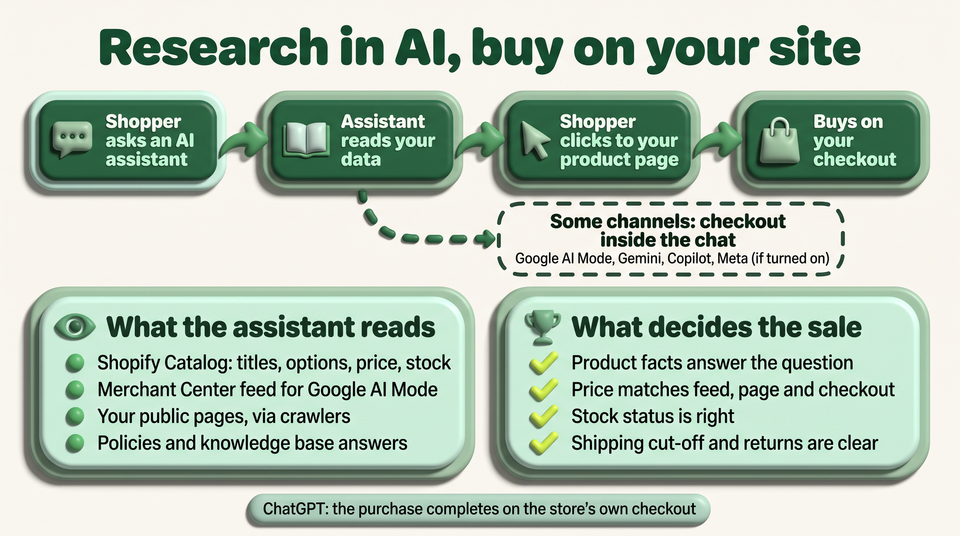
Mostly on the store's own checkout. An AI-referred shopper is someone who asks an assistant such as ChatGPT, Gemini, Copilot or Perplexity for help, then clicks through to a store to look or to buy. Shopify's agentic storefronts help page calls ChatGPT "a discovery-focused referrer platform": its users complete the purchase on your online store checkout, inside ChatGPT's in-app browser or in a new tab.
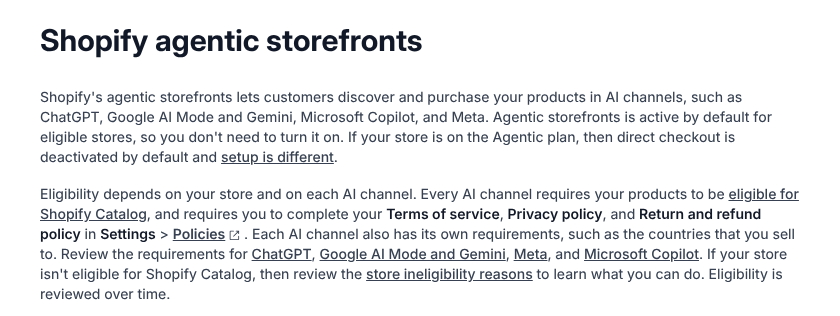
Other channels work differently. For Google AI Mode and Gemini, Microsoft Copilot and Meta surfaces such as Muse, Shopify says customers can buy in the channel's Shopify-powered direct checkout if you have it turned on. Either way, orders show in your Shopify admin with channel or referrer attribution. Shopify also says agentic storefronts are active by default for eligible stores, so an eligible store may already be in these channels without anyone switching them on.
What this means for a Shopify store
Read together, the numbers point to four conclusions.
- Get the channel right, but do not bet the season on it. The growth rates are large and the base is small. Adobe called last season's base modest; Shopify calls this year's volume still small.
- The product page is the landing page. If AI channels send shoppers straight to product pages more often than organic search does, the page an assistant links to may be the only page a buyer sees before checkout.
- Specific facts win. Shopify tied its long-tail AI sales to assistants surfacing very specific products. A product that states its size, material, compatibility and what is in the box gives an assistant something to match.
- Policies are now part of the product. Shopify requires a completed Terms of service, Privacy policy and Return and refund policy for every AI channel, and agents can quote your shipping and returns answers from its knowledge base.
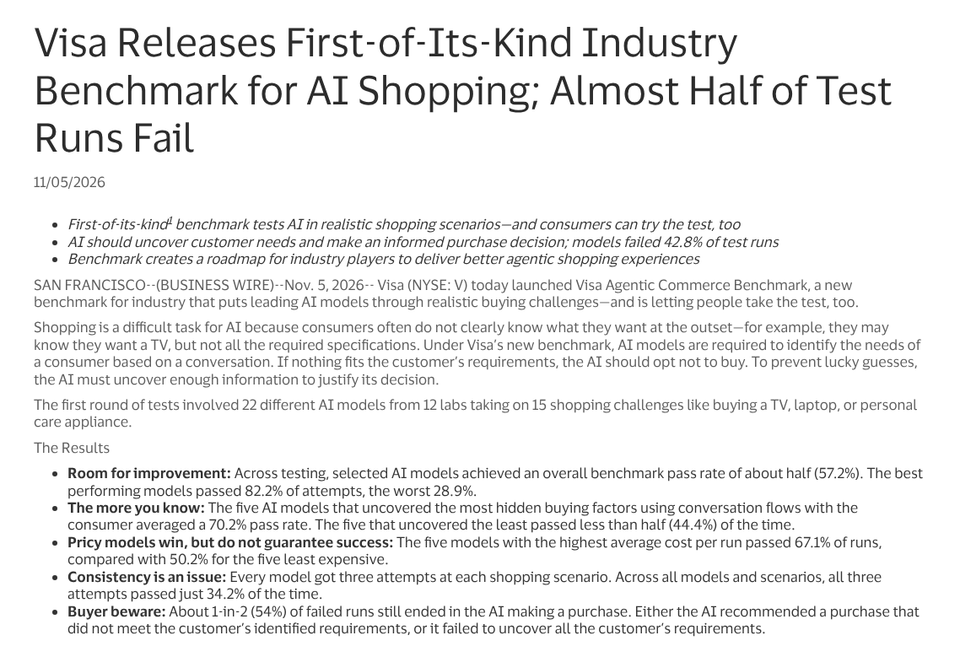
Visa's Agentic Commerce Benchmark, released on 5 November, tested AI models, not stores, but its results are a warning. It put 22 AI models from 12 labs through 15 shopping challenges. Runs failed 42.8% of the time, and about 54% of failed runs still ended in a purchase, either of a product that did not meet the buyer's stated needs or before the agent had uncovered them all. The five models that uncovered the most hidden buying factors passed 70.2% of runs, against 44.4% for the five that uncovered the fewest. Visa says it will extend testing to checkout and payment later. Our reading is narrow: when the facts a buyer cares about are written plainly on the page and in your product data, an agent has less to guess, and a guess is how a wrong order turns into a January return.
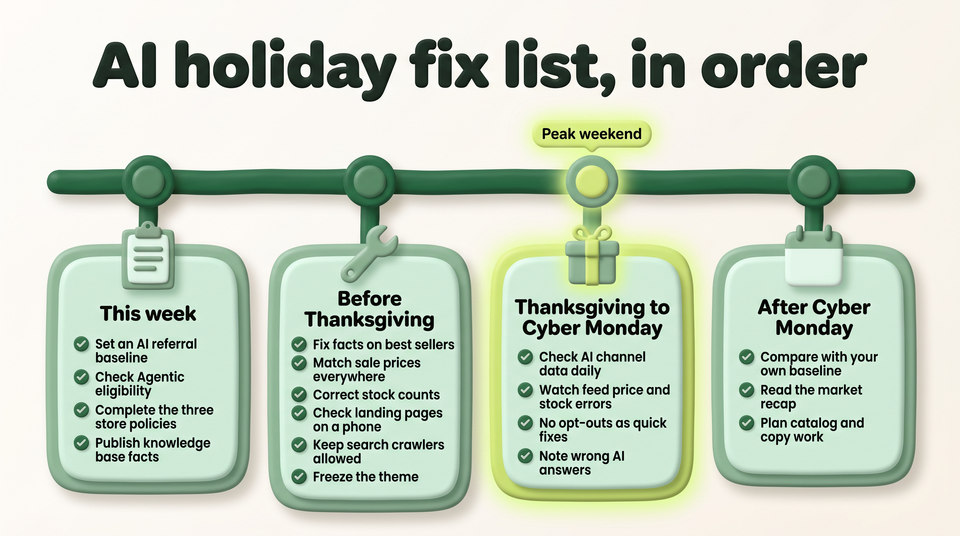
The pre-Black Friday fix list, in order of time left
With about two weeks to go, order matters more than ambition. Almost every step below uses tools you already have, changes data or settings rather than code, and can be undone. For the general pre-peak basics, such as checkout tests and broken links, our ecommerce website checklist covers the rest.
This week: measure and check eligibility
- Set a baseline for AI referrals. In Shopify, go to Sales channels > Agentic. Shopify's help page says it shows sales, orders, online store sessions and online store conversion for each AI channel (not yet for headless stores). For the wider view, Analytics > Reports > Sessions by referrer shows where visits come from, and reports can be filtered by human and bot traffic.
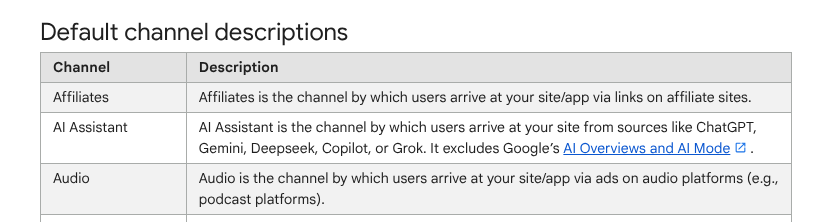
- Set up the same view in GA4. Google's default channel group has an AI Assistant channel for visits from sources like ChatGPT, Gemini, Deepseek, Copilot or Grok, and it excludes Google's AI Overviews and AI Mode. Perplexity is not among the examples Google names, so check where perplexity.ai visits land in your property (AI Assistant or Referral) before you report on it.
- Write this year's numbers down week by week. Shopify's report page says a session measurement change rolled out from 21 to 23 September 2026, and that comparisons across it should be treated as a measurement change. Its changelog post says to treat reports from 21 September as a new baseline for sessions, conversion rate and other session metrics (orders and sales are not affected). A year-over-year view of sessions can mislead you this season, so build your own baseline now.
- Read what the Agentic section says about eligibility. It shows how many products you have in Shopify Catalog, or an Ineligible warning with a reason you can click. Then confirm that your Terms of service, Privacy policy and Return and refund policy are filled in under Settings > Policies, because Shopify lists them as a requirement for every AI channel.
- Review and publish your knowledge base. Shopify's knowledge base is where agents get answers that are not about a product: your return process, shipping timelines, payment methods and gift services such as gift wrapping or gift receipts. Facts that Shopify generates from a scan of your store stay unpublished until you publish them. Add your holiday shipping cut-off and any extended return window, and put the same words on a public page, since Shopify asks that the storefront match.
Before Thanksgiving (26 November): product facts, prices, stock and pages
- Fix product facts on last December's best sellers first. The search preview in the Agentic section shows how your products might rank for a query, and Shopify's listing insights score description completeness, image coverage, reviews, variant and option completeness, and policy completeness. Shopify checks whether option names contain acronyms or numbers that agents find hard to understand, so a name like "BLK/GRY" is worth spelling out as "Black and grey". If key attributes live in metafields, map them on the Channel mapping page described in Shopify's Catalog help. Our metafields guide covers the data side.
- Make sale prices match everywhere. Shopify Catalog lets you choose whether its list price is the current price or the compare-at price, and agents may use it to show strikethrough pricing. If you also feed Google, Merchant Center's product data specification asks that the sale price match your landing page and checkout, and that price and availability match your landing page, checkout and structured data. It also says that without a sale price effective date the sale price always applies. Set start and end times for the weekend's prices, then test one product from feed to checkout.
- Keep stock status honest. Shopify says Catalog updates continuously, so AI channels receive your latest inventory and prices. That only helps if the inventory in Shopify is right. Count stock on promoted products, correct it before Thanksgiving, and make sure sold-out variants read as sold out.
- Open the pages AI visitors land on, on a phone. Adobe expects a record 63% of Thanksgiving online spend to come through mobile devices. On your best sellers, and on any product page you can see AI visitors landing on, check that the offer shows on the page itself (not only in a homepage banner), the shipping cut-off sits near the buy button, the return window is one tap away, and the variant an assistant is likely to name exists and has stock.
- Do not block the crawlers that send buyers. Open your store's /robots.txt. OpenAI's crawler documentation says sites that opt out of OAI-SearchBot will not be shown in ChatGPT search answers, while GPTBot is the training crawler and is controlled separately. Google's crawler documentation says Google-Extended governs Gemini training and grounding in Gemini Apps, and does not affect inclusion in Google Search. If your theme has a robots.txt.liquid template, compare its output with Shopify's default, as Shopify's developer docs advise.
- Freeze the theme. Pick a day after which nothing in the theme, apps or checkout changes until December.
Thanksgiving to Cyber Monday: watch, do not tinker
- Check the Agentic performance view and your referrer report once a day, against the baseline you wrote down.
- If you use Merchant Center, watch for price and availability problems. Google's specification warns that incorrect or missing product information can cause disapprovals or limited eligibility.
- Do not treat opt-outs as a quick lever. Shopify says switching off Shopify Catalog access can take up to 7 days to take effect, and setting a product to Unlisted also hides it from sitemaps, Google and your own store search.
- Note any customer who mentions an AI answer that was wrong (a price, a returns rule). Those notes are your January fix list.
After Cyber Monday: compare and plan January
- Compare AI-channel sessions, orders and conversion with the baseline you built, not with last year's report.
- Read Adobe's season recap when it lands (last season's came out on 7 January) and compare it with your own trend, keeping the definitions straight.
- Put the bigger jobs on the January list: catalog mapping, rewriting thin product copy, and a proper technical check. Our GEO page explains how we approach that work, and our agentic commerce setup page covers the channel settings in more depth.
What not to spend time on before Thanksgiving
Some work is worth doing, just not in the fortnight before the peak.
- A theme rebuild or redesign. There is no time left to test it.
- An llms.txt or agents.md app. Shopify's Catalog help says Shopify already serves /agents.md, /llms.txt and /llms-full.txt for your store, and that you don't need a third-party app to generate them. Headless storefronts may not serve them on their own domain; open
yourdomain.com/llms.txtto check. - "AI SEO" quick fixes. Extra schema, FAQ markup or a bulk AI rewrite of every description are often sold as ways into AI answers. Our GEO page lists schema and llms.txt files among the things we will not sell as growth levers, because the best tests we found did not show a reliable lift. A bulk rewrite also risks changing the facts you just checked.
- Launching your own shopping agent this month. Salesforce predicts that 1 in 3 ecommerce sites will have a site-specific shopper agent by Cyber Week, but a prediction is not a deadline, and Visa's results show how often today's models miss what a buyer needs.
- Blocking every AI bot to stop scrapers. Shopify's Catalog help says it handles bot management at the network layer and does not recommend a proxy in front of a Shopify store. Blocking OAI-SearchBot also takes you out of ChatGPT search answers.
When it is fine to sit AI channels out
Not every store needs them. Shopify's help pages say agentic storefronts support only direct-to-consumer sales, and that the ChatGPT channel needs a store that sells to customers in the United States. You also have to accept Shopify's supplemental terms. If you sell wholesale only, or you do not want your catalog shared, switching off Catalog access is a fair choice. Just know what it does not do: Shopify says your products can still be found through web crawling and indexing.
FAQ
How much holiday traffic will come from AI in 2026?
Nobody has published a reliable share for US retail. Adobe forecasts growth of 130% in AI-referred visits to US retail sites without giving a share. Salesforce predicts that 20% of global holiday ecommerce traffic will come from AI chat agents, but that count includes backend agents and price scrapers. Your own referrer data is the only number that describes your store.
Do shoppers buy inside ChatGPT?
Not through Shopify's ChatGPT channel. Shopify's ChatGPT help page says buyers are redirected to your online store checkout, shown in ChatGPT's in-app browser or a new tab, so your payment methods and branding apply. Google AI Mode and Gemini, Microsoft Copilot and Meta surfaces can use direct checkout instead, if it is turned on.
Should I block AI crawlers before Black Friday?
Not the ones tied to search answers. The crawler step in the fix list above explains which bot does what. Shopify's Catalog help adds that blocking crawlers does not stop Shopify Catalog sending data to your active AI channels.
Will schema or an llms.txt file get my products into AI answers by Black Friday?
Do not count on it. Shopify serves /llms.txt and /agents.md on Online Store storefronts, and the tests we have read showed no reliable lift from schema or llms.txt. Spend the time on product facts, prices, stock and policies.
Do I need to turn on Shopify's agentic storefronts?
Usually not. Shopify says they are active by default for eligible stores. Open Sales channels > Agentic to see whether your store is eligible, which channels are active and whether direct checkout is on.
Is it too late to do anything for this season?
No. Most of the fixes above are data and settings: policies, knowledge base facts, product attributes, sale prices and stock. They take days, carry little risk and still count after the holidays.
Your next step
Open Sales channels > Agentic today. Write down what it says about eligibility and AI-channel sessions, then work down the list from the top. If you would like a second pair of eyes on your product data, policies and crawler settings before Thanksgiving, get in touch and tell us what you sell and what you have already checked.