Shopify Dropshipping Apps: How to Choose One and Test It Before You Sell
What the main Shopify dropshipping apps and supplier networks actually do, the honest risks (shipping, quality, margins, duties, ad rules), and a test-order process to run before you launch.


A dropshipping app does one job: it connects your Shopify store to a supplier who ships to your customer. Choosing the app is the easy part. The hard parts are supplier reliability, shipping times, margins and returns, and most of those depend on the supplier and the product, not on the app. This guide, covers how it works, what the main options do, what can go wrong, and how to test a supplier before you spend on ads.
We do not promise income here, and we do not quote success rates. Dropshipping is retail with someone else's stock, and it has the same pressures as any retail.
How dropshipping works on Shopify
Shopify describes the flow in four steps. A customer orders from your store. Your store sends the order to your supplier. The supplier prepares it. The supplier ships it straight to your customer. You never touch the stock.
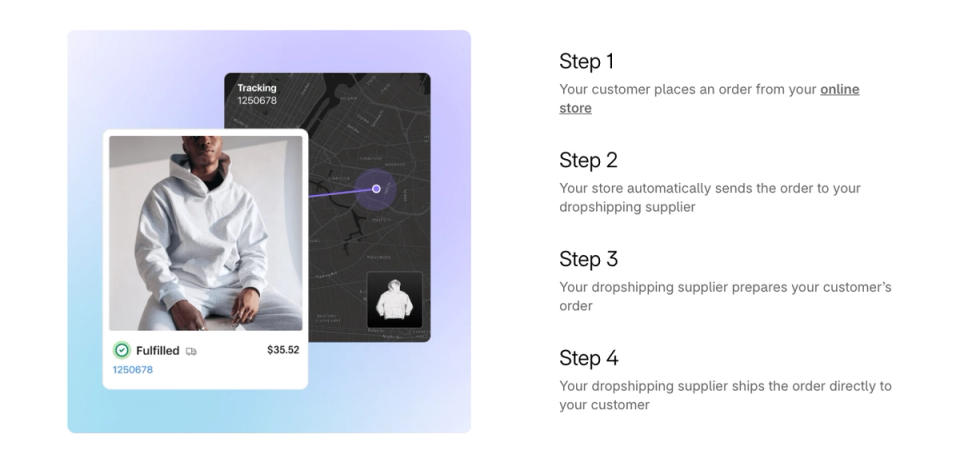
Shopify's beginner's guide to dropshipping names three ways to set this up:
- Shopify Collective. Shopify's own network of Shopify brands that act as suppliers.
- A dropshipping app. A third-party app connects you to one or more supplier networks.
- A direct deal with a supplier. More control and better terms are possible, but more manual work, and you need a backup when they run out of stock.
Most beginners start with options 1 or 2. Both are covered below.
The honest risks
The same guide says dropshipping apps give you access to many products, but that also means competition from other sellers listing the same items. Beyond that, these are the problems we see most.
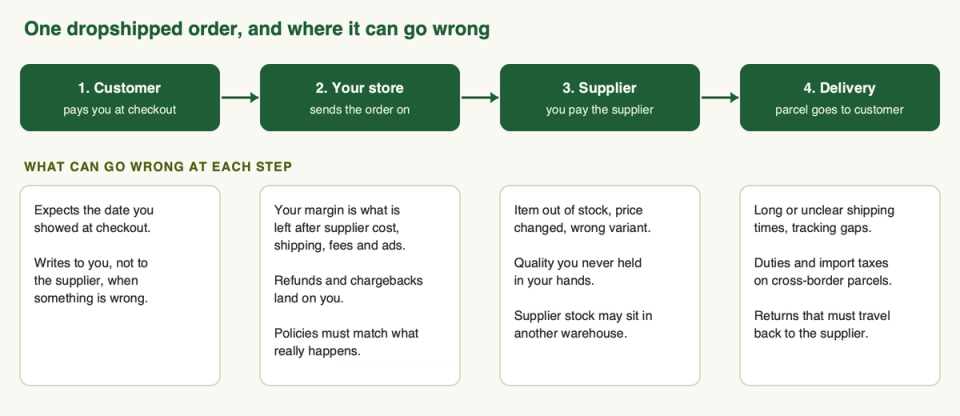
- Shipping times. If a supplier ships from overseas, delivery takes longer and import taxes may apply, as Shopify's own guide notes. Even domestic suppliers can be slow if the item is held somewhere else. A dropshipper quoted in Shopify's suppliers article says that when a supplier does not have the item in its own warehouse, it can add around 10 days. Treat that as one person's experience, not a rule.
- Quality control. You do not see the product before it ships. Shopify's guide suggests ordering product samples before committing. Do that.
- Margin pressure. Your margin is the sale price minus supplier cost, shipping, app fees, payment fees and ads. Shopify says it recommends Collective suppliers leave retailers a margin of 20% to 50%, with 5% as the minimum, which shows how thin the low end can be. If many stores sell the same product, prices get pushed down.
- Returns. The customer returns to you, but the stock sits with the supplier. Who pays return shipping, and whether the supplier accepts the item back, is set by the supplier's terms. Shopify Collective says it automates returns between retailer and supplier. For other apps, read the terms.
- Supplier reliability. Stock-outs, price changes and slow replies hit you directly. You can only see this over time, so test first.
- Customs and duties. See the next section. The rules for low-value parcels changed in the US, the EU and the UK over the last year.
- Ad and store policies. Google's Merchant Center policy lists, among the practices it does not allow, concealing where products ship from to create a false impression of local inventory or fast delivery, and listing items as available when you cannot fulfil the orders. Delivery promises must match reality. We did not read the policies of other ad platforms for this guide, so read theirs before you run ads.
- Payment provider rules. Shopify's Payments terms say some business categories are prohibited or restricted, with lists published by each payment processor. One app listing we read, Modalyst's, says dropshipped products that break those terms cannot use Shopify Payments. Check the list for your country before you source a category you are unsure about.
- Store policies and consumer law. In the UK, GOV.UK's distance selling guidance says you must tell customers how long delivery takes before they order, and that customers can cancel up to 14 days after delivery. Other countries have their own rules. Your shipping and returns pages must describe what really happens, not what you hope will happen.
Customs and duties on low-value parcels
If a supplier ships to your customer from another country, tax rules can add cost or confusion. These were current when we checked, but they change, so confirm on the official pages.
- United States. US Customs and Border Protection says duty-free de minimis treatment for imports of $800 or less has been suspended for all countries since 29 August 2025, and its rules published on 24 June 2026 suspend it indefinitely. See CBP's release.
- European Union. From 1 July 2026 the EU applies a temporary customs duty of €3 per item on low-value consignments (up to €150) imported from outside the EU, until 1 July 2028. The Commission's customs reform page also says a €2 Union handling fee applies from 1 November 2026. Read the Commission's guidance for which items and sellers are in scope.
- United Kingdom. For goods worth £135 or less sent from outside the UK to customers in Great Britain, HMRC guidance says the seller charges and accounts for UK VAT at the point of sale. The government has also announced it will scrap customs duty relief on goods of £135 or less, brought forward to October 2028.
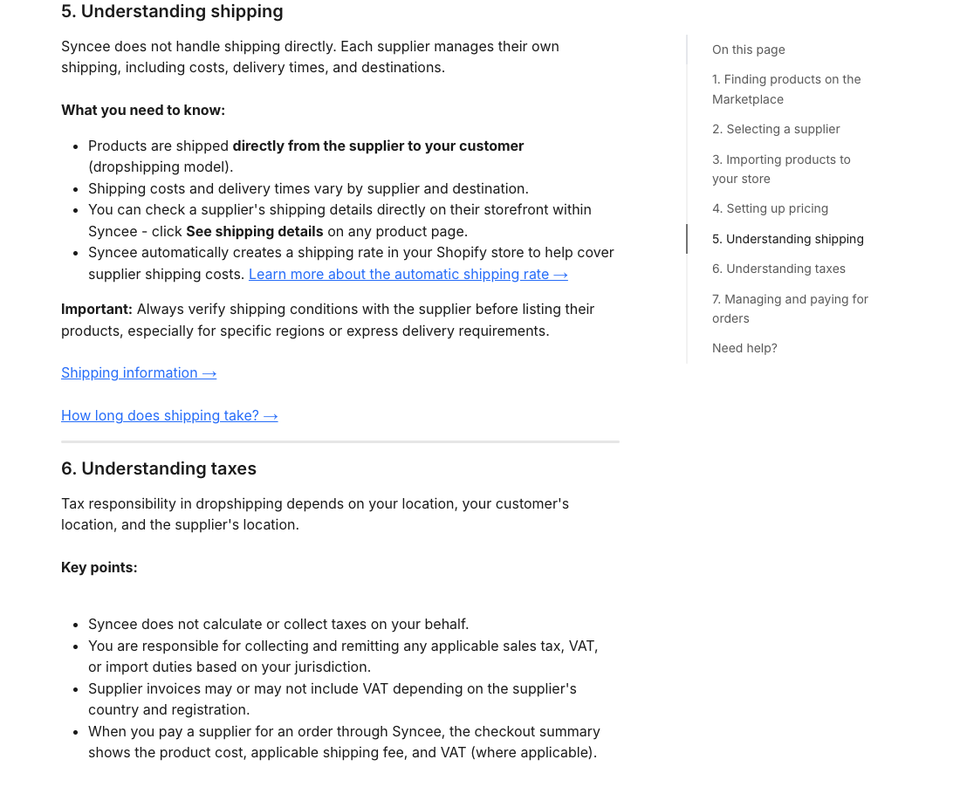
Dropshipping apps do not take this off your plate. Syncee's help centre, for example, says it does not calculate or collect taxes for you and that you are responsible for any sales tax, VAT or import duties. Ask each supplier who pays duties, and whether the price you see includes them. For tax advice, talk to an accountant who knows your markets.
The options at a glance
We read each app's Shopify App Store listing and the vendor or Shopify pages named in the sources. We did not install any of them on a live store, so what follows is what the listings and vendor pages say, plus our judgement.
| Option | Where the listing says products come from | Pick this if | Skip this if |
|---|---|---|---|
| Shopify Collective | Shopify brands in nine countries, including the US, UK, Canada, Germany and Australia | You want real brand products with synced stock | You want a huge catalog of cheap generic items |
| DropCommerce | US and Canada | Your customers are in North America | You sell mainly outside North America |
| Spocket | US and EU suppliers, plus other countries | You sell in the US or Europe and want shorter shipping | You want the widest range at the lowest item cost |
| Syncee | US, Canada, EU, UK, Brazil and more | You want to filter by ship-from country | You want one supplier handling everything |
| DSers | AliExpress, Alibaba and 1688 | You have already chosen AliExpress sourcing | Delivery speed is your main promise |
| CJdropshipping | China, with warehouses in other countries per Shopify | You want China sourcing with some local warehouse options | You need every item to ship from a local warehouse |
| Zendrop | US suppliers and China fulfillment | You want one platform with branded packaging options | You need one fixed delivery time for all items |
| Modalyst | US and international locations, per its listing | You are a creator or brand exploring its marketplace | You need a lot of evidence before you commit |
Option by option
Shopify Collective
Collective is Shopify's own app for importing products from other Shopify brands. Its listing says products sync in real time, orders go to the supplier, shipping costs are fetched at checkout based on weight and customer location, and you set the rules for returns and refunds. Shopify's Collective page describes a multi-brand checkout and says you only pay suppliers for products you sold once they have shipped them. The listing shows nine sourcing countries.
Pick this if you want products from real brands with inventory synced to your store, and you value having Shopify run the payments between you and the supplier. Skip this if you need a large catalog of low-cost generic goods, or if your store or currency is not in a supported country. We could not open Shopify's eligibility page (it blocks automated readers), so check it in your admin before you plan around Collective.
DropCommerce
DropCommerce's listing says its suppliers are in the US and Canada, and it claims delivery in 2 to 7 days. That is the vendor's claim, so test it. The listing shows a free plan that includes browsing suppliers and ordering product samples.
Pick this if your customers are in the US or Canada and you want shorter shipping. Skip this if you sell mainly in Europe or elsewhere, since the listing shows only the US and Canada as sourcing locations.
Spocket
Spocket's listing is titled for US and EU dropshipping and also lists suppliers in many other countries. It lists branded invoicing and a way to chat with suppliers about order status.
Pick this if you sell into the US or Europe and want to see where each product ships from before you list it. Skip this if your plan relies on the very lowest item prices, which usually come with longer shipping.
Syncee
Syncee is a marketplace of suppliers. Its help centre says you can filter by ship-from country, that some products need supplier approval, and that each supplier sets its own shipping costs and delivery times. Orders sync to Syncee, you pay the supplier there by card or PayPal, and the supplier ships. Once an order is paid and forwarded you cannot change it in Syncee, so address mistakes mean contacting the supplier. The listing shows a free plan.
Pick this if you want European, UK, US or Canadian suppliers and are happy to read each supplier's terms. Skip this if you want a single company to own shipping, returns and quality across the catalog. With a marketplace, every supplier has its own rules.
DSers
DSers focuses on AliExpress, Alibaba and 1688 products. Its listing mentions one-click listing, bulk ordering to AliExpress, automatic order status and tracking sync, and AI supplier selection. A free plan is listed.
Pick this if you have already decided to source from AliExpress and want to stop placing orders by hand. Skip this if fast delivery is your promise to customers, or you are not ready to handle customs and long shipping times. Many other stores can list the same AliExpress products too.
CJdropshipping
CJdropshipping's listing says it handles sourcing, order sync and fulfillment, offers a shipping calculator, DIY product bundles, and print on demand and custom packaging. It claims a general delivery time of 2 to 3 days from its local warehouses. That is the vendor's claim for those warehouses only. Shopify's suppliers article says CJ has warehouses in China, the US and Poland, and that print on demand and branded dropshipping are limited to its China warehouse, which can mean longer shipping for those items.
Pick this if you want China sourcing but also want local warehouse options for some items. Skip this if every product must ship from a local warehouse. Check each product's ship-from country.
Zendrop
Zendrop's listing says it offers more than a million items from US and global suppliers, automated fulfillment and tracking, print on demand, custom packaging and 3PL. Shopify's suppliers article says Zendrop's products from China can take up to 15 days plus processing time, while branded packaging is possible on those.
Pick this if you want one platform that can grow from simple dropshipping toward branded packaging. Skip this if you need one fixed delivery time across the catalog.
Modalyst
Modalyst's listing describes a marketplace for creators and brands, with warehousing and fulfillment from the US and international locations, and a note about Shopify Payments eligibility. We read only the listing, not the vendor's own site, so we would test it carefully before relying on it.
Pick this if you are a creator or small brand exploring a branded product line. Skip this if you need a lot of proof before committing.
If you want your own designs on products rather than someone else's catalog, read our guide to print on demand apps for Shopify.
How to choose
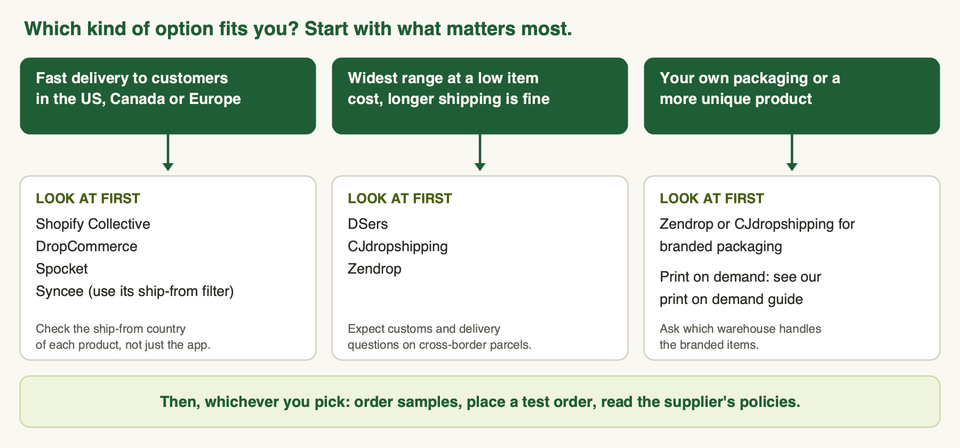
Ask these questions in this order.
- Where are your customers, and where does each product ship from? The ship-from country, not the app, decides delivery time and customs.
- What delivery time can you honestly promise? Use the slowest realistic case from your test orders, not the best one.
- Can you make money after all costs? Include supplier cost, shipping, app fees, payment fees, ads, returns and refunds. Our guide on what Shopify takes from each sale covers the Shopify side.
- How will you price shipping? Free shipping needs the cost built into the price. See free shipping on Shopify.
- Can you stand out? If a dozen stores sell the same item, you compete on price alone. Better photos, copy and your own brand help. Shopify's own guide tells sellers not to rely on default supplier descriptions and images.
What to check in a supplier
Before you list a single product, get answers to these. Ask in writing so you have a record.
- Is the item in your own warehouse today, or does it come from another supplier?
- Where does it ship from, and to which countries? What is the processing time before it ships?
- How do you price shipping, and does the price include duties for the countries I sell to?
- Do you provide tracking, and when does it appear?
- What is your returns policy? Who pays return shipping, and do you accept opened items?
- What happens when an item goes out of stock or the price changes? Do you notify me?
- Can I order a sample, and does the sample ship the same way as a customer order?
- Is there branding on the box or packing slip that shows another store's name or prices?
- How fast does support reply, and can I reach a human?
- Do you have the right to sell this brand or design? Selling goods you are not authorized to sell is a legal and payment risk.
A test-order process
Run this before you spend on ads. It costs a little, and it shows you what your customers will see.
- Shortlist two or three suppliers. Read their shipping, returns and processing pages first. Ask the questions above.
- Order samples to a real address. If you can, use an address in your main target country, in the same way a customer would. Order the variants that matter, such as sizes or colors.
- Write down the dates. Note when you ordered, when it shipped, when tracking appeared and when it arrived.
- Inspect the product. Compare it with the listing photos. Check the packaging, labels, smell and fit. Check what is in the box, including any invoice or price slip.
- Place a test order through your own checkout. Use a cheap item and compare what the customer sees (price, shipping, taxes, emails) with what the app charges you. Work out your real margin on that order.
- Test a return and a problem. Contact the supplier about a return or a wrong item, and time the reply.
- Set your promises from the results. Put real delivery times, return rules and ship-from information on product pages and in your policies. Our launch checklist covers the pages to check before you go live.
- Re-test now and then. Suppliers change prices, stock and shipping partners.
Only after this should you list the product in Google Merchant Center or run paid ads.
Frequently asked questions
Is dropshipping on Shopify still worth trying?
It can work as a way to test products without buying stock. It is also low-margin retail where other stores can sell the same item, and where the supplier controls delivery. We cannot promise income, and you should not budget as if you will earn any.
Do I need a dropshipping app?
No. Shopify's guide lists three routes: Collective, a third-party app, or a direct deal with a supplier. Apps save time on importing products and passing orders along, but a direct supplier can give better terms and more control.
Which app gives the fastest shipping?
None can promise it, because speed depends on the product and where it ships from. Options that list suppliers in the US, Canada, the EU or the UK, such as Collective, DropCommerce, Spocket and Syncee, are a better starting point if speed matters. Check each product's ship-from country and test it.
Who handles returns and refunds?
You face the customer, and the supplier's terms decide what happens to the stock. Collective says it automates returns between retailer and supplier. With other apps, read the supplier's returns policy before you sell and match your own policy to it.
Who pays customs and import taxes?
It depends on the product, the supplier and the destination, and the rules changed recently in the US, EU and UK (see above). Ask the supplier, and remember that Syncee's help centre says the seller is responsible for sales tax, VAT or duties.
Can I use Shopify Payments for dropshipping?
Shopify Payments has prohibited and restricted business categories, with lists published by each payment processor. Check the list for your country, especially if you plan to sell a category you are unsure about.
Can I use the supplier's photos and descriptions?
You can import them, but Shopify's guide advises against relying on them. Write your own copy and use your own images where you can. Other stores selling the same item are using the same material.
Can dropshipping ads get my account in trouble?
They can if they mislead. Google Merchant Center's policy does not allow hiding where products ship from to suggest fast local delivery, or listing items you cannot fulfil. Make delivery claims match your test results.
Need help setting this up?
If you want a second opinion on your store setup, shipping settings or theme before you launch, talk to us. We can look at what is slowing you down, but the supplier tests above are work only you can do with your own products.