What Is Ghost Commerce? Meaning, Risks and How to Start
Ghost commerce" has no single definition. We compare how Shopify, tool vendors and the food trade use it, then cover how a no-stock Shopify store works, the legal duties that stay with you, and how to start.


"Ghost commerce" is a loose term, not a standard one. Most ecommerce writers use it for an online store that sells products made, stored and shipped by someone else. Others use it for affiliate sites, and food writers use it for delivery-only kitchens. This guide shows who means what, then covers how the no-stock version works on Shopify, which legal duties stay with you, and how to start.
What "ghost commerce" means depends on who is writing
We did not find a definition from a regulator, a standards body or a platform's legal terms. What exists is guides written by vendors and publishers. They agree on one idea: the business has no visible shop or warehouse of its own. They disagree on almost everything else.
Meaning 1: the no-stock online store
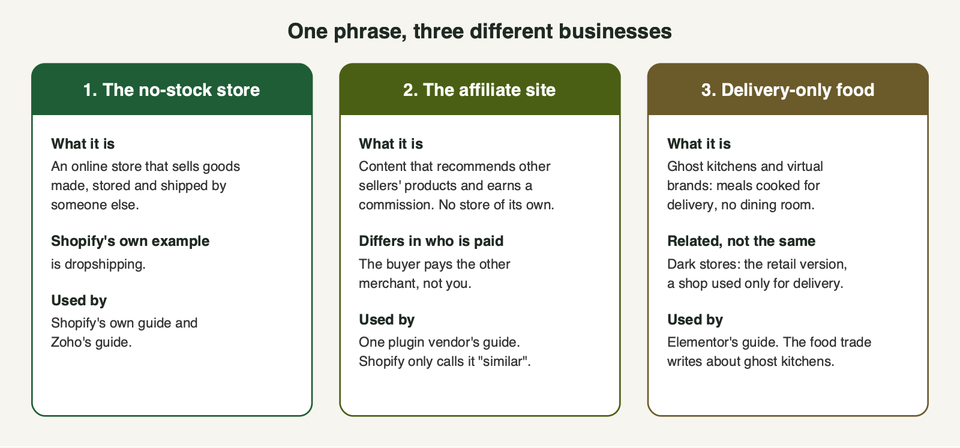
Shopify's guide says ghost commerce is running an online business with no physical storefront and no inventory you have to store. It lists three traits: an online store, products from third-party manufacturers, and a slim profit margin. Its own example is a dropshipping business, where a supplier stores and ships the goods while the merchant handles marketing and customer service. Zoho's guide describes the same thing: you build the brand and the storefront, a supplier handles production, stock and shipping, and you forward each order.
Shopify's own example is dropshipping. If you search for ghost commerce on a Shopify blog, this is the meaning you will find.
Meaning 2: the affiliate site
Shopify says this model is "very similar to affiliate marketing". A plugin vendor's guide, Acowebs, goes further. It describes a business that never owns stock, never fulfils orders and earns commission on tracked links. The same page also calls dropshipping a core ghost commerce model, so even this source mixes the two.
So the term is used inconsistently, even on a single page. The basic difference is whether the customer pays you or pays another merchant. If a writer says "ghost commerce", ask which one they mean.
Meaning 3: delivery-only food and "ghost retail"
In food, the word "ghost" has a clearer meaning. A ghost kitchen, also called a dark or cloud kitchen, prepares food only for delivery. DoorDash's merchant guide separates two ideas: the ghost kitchen is the place, and a virtual restaurant or virtual brand is the online-only concept that can run out of it. It also notes that some operators run several brands from one kitchen.
Elementor's guide uses "ghost commerce" itself for this food model. CNBC's 2021 report is more cautious. It describes virtual brands that live only on third-party delivery apps and rely on those apps for marketing, and it says these ideas had been copied so often that they lost some of their edge. Sendbird, a software vendor, says retail followed with dark stores: shops that exist only to fill online orders.
None of this has anything to do with a Shopify merchant who forwards orders to a supplier. If your goal is to open a store, the food meaning is background only.
Which meaning this guide follows
The rest of this guide is about meaning 1, the no-stock store, because that is what most ecommerce owners are asking about. We also cover the affiliate route briefly, since it is the other version people mix up with it. If a course, tool or "done for you" offer uses the phrase, check which model it really sells before you pay.
How a no-stock store works on Shopify
The flow has three steps. A customer buys from your store. Your store passes the order to a supplier. The supplier ships the parcel to the customer.
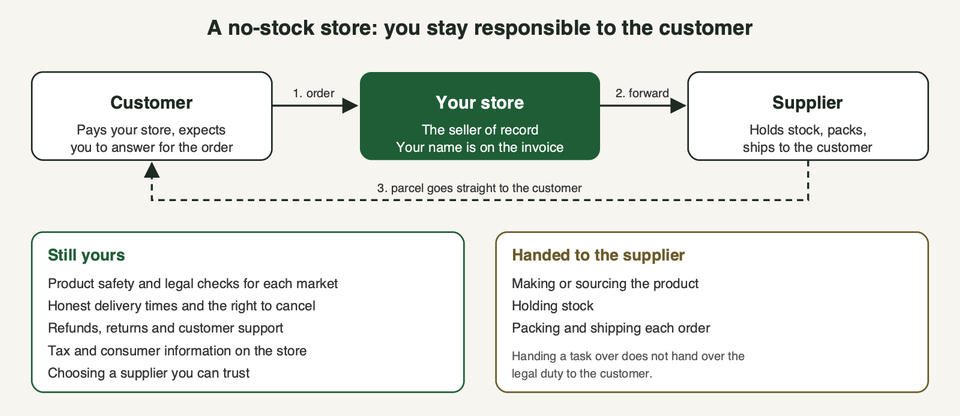
Shopify's dropshipping guide calls the store the seller of record. That means you set prices, take payment including taxes, and appear on the invoice and packing slip. You are also the first point of contact for returns, refunds and support, even for problems you did not cause.
Two ways to source on Shopify
- A dropshipping app plus suppliers. You connect a supplier directory or marketplace, import products and let the app forward orders. Our dropshipping apps guide compares the options.
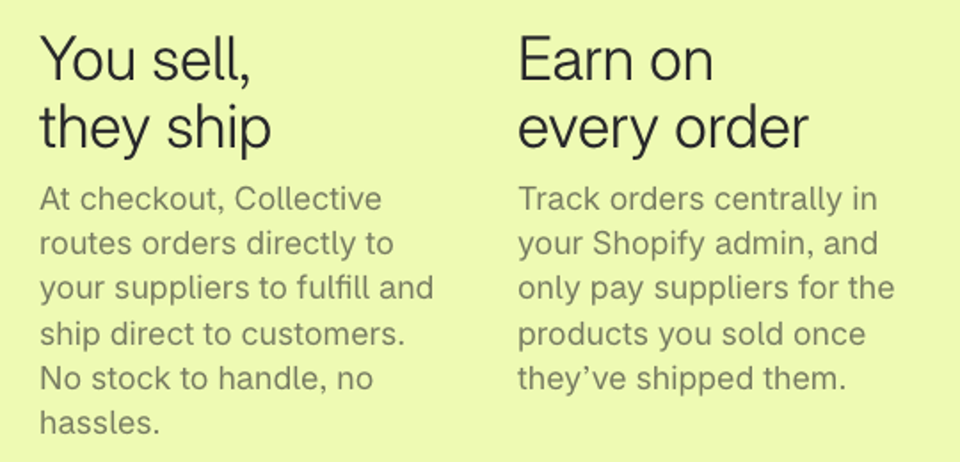
- Shopify Collective. Shopify Collective lets a retailer import products from other Shopify brands without holding inventory. Per Shopify's page, orders are routed at checkout to the supplier, who ships direct to your customer, and you pay the supplier only for products sold once they have shipped. The retailer sets the rules for returns and refunds.
If you want your own branded product with no stock, print on demand is the usual route. See our print on demand app guide.
Pick this if, skip this if
| Route | Pick this if | Skip this if |
|---|---|---|
| Dropshipping app and suppliers | You want a wide range to test quickly and can answer customer problems yourself | You cannot tolerate slow or uneven delivery from some suppliers |
| Shopify Collective | You want to sell established Shopify brands and keep checkout and returns inside Shopify | You need products no Collective brand offers |
| Print on demand | You have your own designs and want a branded product | You want fast delivery and many unrelated products |
| Affiliate site | You want to earn from content and never handle orders | You want customers to buy on your own store |
| Virtual food brand | You already run a kitchen and want a delivery-only concept | You sell physical goods that ship by post |
The trade-offs Shopify's own guide admits
Shopify lists the drawbacks plainly: little control over product quality and shipping, a crowded market where many sellers list similar products, and a small markup over cost of goods. Its dropshipping guide adds that overseas suppliers can mean long delivery times and that dropshipping products are rarely exclusive to one store, which makes a distinct brand harder.
We would add the point most guides skip. The low barrier to start is the same reason the market is crowded. A store that sells what everyone else sells, at the price everyone else charges, has nothing to protect it. The way out is a clear niche, a brand people remember, and service that suppliers cannot copy. We have not tested these sources' claims about margins, and we do not repeat any margin figures here.
Legal and policy duties that stay with you
Using a supplier changes who packs the box. It does not change who answers to the customer or the regulator. This is general information, not legal advice. Talk to a lawyer about your markets.
Platform rules
Shopify's Acceptable Use Policy says you are responsible for following the rules of your platform, your partners and the law. It also says most product eligibility disputes start outside Shopify, with regulators and rights holders, and that account-level action is possible if you act in bad faith or defraud buyers. Shopify's dropshipping help page says you must comply with the laws that apply to selling products as if you were their retailer, and that it is your responsibility to offer safe products. It also has sections on product liability, recalls, shipping timeframes, refunds, cost-inclusive pricing and VAT for dropshipping into the EU. Read it for the markets you sell in.
Product safety
In the EU, the General Product Safety Regulation says an offer sold online counts as made available in the EU if it is targeted at EU consumers. A product should not be placed on the market without an economic operator established in the EU who is responsible for it, and that operator's name and contact details must appear on the product, packaging, parcel or an accompanying document. If you sell to the EU from the US or the UK, ask each supplier who plays this role. A supplier that cannot answer is a risk to your store, not just to theirs. Ask each supplier for:
- the name and EU contact details of the responsible economic operator
- safety documents, test reports and instructions for your markets
- warnings and instructions in the language of the country you sell to
- how recalls and complaints are handled
Delivery promises and refunds
In the US, the FTC's Mail, Internet, or Telephone Order Merchandise Rule says you need a reasonable basis to expect to ship within the time you state, or within 30 days if you state none. If you cannot, you must offer the buyer a choice: agree to the delay or cancel for a prompt refund. If your supplier is slow, that is your problem, so state delivery times you can really meet.
In the UK, GOV.UK's distance selling guidance says you must give the customer delivery arrangements and how long goods will take before the order, tell them they can cancel up to 14 days after delivery, and deliver within 30 days unless you agreed otherwise.
Affiliate links and disclosure
If you earn commission from a link, the FTC's rule on disclosure of material connections says a connection that could affect how much weight an endorsement carries must be disclosed clearly and conspicuously when the audience would not expect it. Put the disclosure next to the link, not on a distant page.
Courses that sell a "ghost store"
Be careful with paid programs that promise a ready-made store and income. The FTC's Business Opportunity Rule covers some arrangements where a seller takes a payment and promises to provide outlets, accounts or customers, including internet outlets. It requires a reasonable basis and written proof for any earnings claim, plus a specific earnings claim statement. If a seller shows you big income claims and no such document, treat that as a warning sign. We have not reviewed any particular course.
How to start
- Choose the model. Decide whether you are building a no-stock store, an affiliate site or a branded print on demand shop. Do not buy anything until you can say which one it is.
- Pick one niche and a small range. A narrow range is easier to check for quality and safety.
- Vet suppliers before you list. Ask where goods ship from, the real delivery time, the return process, and who holds product safety documents for your markets. Order a sample of anything you plan to sell.
- Set up the store. Our Shopify store setup guide and launch checklist cover the basics. Add clear delivery and return policies, and show your business details.
- Do the sums yourself. Take the supplier cost, shipping, payment fees, app fees and ad spend, and find what is left. Do not rely on a published "average margin".
- Test a real order from start to finish. Check the confirmation, the tracking, the packing slip and what the customer receives.
- Review it again after launch. Watch late deliveries, refunds and complaints. Drop suppliers that cause them.
Our ecommerce website checklist is a useful final pass. If you want a second pair of eyes on the store build, supplier connections or policies, you can talk to us.
Questions people ask
Is ghost commerce legal?
The model itself is legal in the sense that selling goods you do not hold is allowed. Shopify's guide says it is. What matters is how you run it: product safety, honest delivery times, refunds, tax and advertising rules all apply to you as the seller. Check the rules in each market.
Is ghost commerce the same as dropshipping?
In most ecommerce guides, nearly. Shopify's example of ghost commerce is dropshipping. Some other writers define it as affiliate marketing instead. Treat the phrase as loose and ask what the speaker means.
Is ghost commerce the same as a ghost kitchen?
No. A ghost kitchen is a place that prepares food for delivery only. A virtual brand is the online brand that can run out of it. Some food writers also use "ghost commerce" for that model, which is why the term is confusing.
Do I need to hold stock?
Not in the no-stock store model. The supplier holds it. You still handle the customer relationship, support and refunds.
Can I do this on Shopify?
Yes. You can use a dropshipping app, Shopify Collective or print on demand. Check each app's terms and Shopify's current policies, and make sure you follow the rules for your markets.
What are the main risks?
Shopify names quality control, competition and thin margins. We would add late deliveries, product safety checks you cannot see, and customers blaming you for a supplier's mistake.
Is it passive income?
Shopify says automation can cut the daily work, but you still run marketing and customer service. Treat any "passive" promise with suspicion, especially in a paid course.
What is the difference between ghost commerce and an affiliate site?
On an affiliate site the buyer pays another merchant and you earn a commission. In a no-stock store the buyer pays you and you pay the supplier. The legal and support duties differ because of who takes the payment.